
Modern public education and mass popular culture often portray the history of science as an epic of “reason triumphing over superstition” and “science opposing religion.” Yet the consensus among historians of science is quite the opposite: the so-called “conflict thesis” is largely a nineteenth-century myth. A growing body of scholarship shows that the birth of modern science was deeply indebted to the biblical worldview. From Copernicus to Newton, every major figure of the sixteenth- and seventeenth-century Scientific Revolution was profoundly shaped by Christian faith. This article will demonstrate how the Bible provided indispensable foundations for modern science and will analyze why other civilizations failed to give rise to it.
Table of Contents
- I. The Foundations of Science — Four Indispensable Biblical Foundations
- II. The Scientific Revolution — The Biblical Worldview Triumphs over Greek Philosophy
- The Truth of the Revolution: A Clash of Worldviews
- Intellectual Shackles: Why Greek Philosophy Could Not Give Birth to Science
- Copernicus’s Challenge: Divine Design Implies Inner Harmony
- Galileo’s Weapon: The “Two Books” Overturn Celestial Perfection
- Kepler’s Obedience: Listening to God’s Cosmic Symphony
- Boyle’s Piety: Experimental Chemistry Brings Greek Essentialism to an End
- Newton’s Cosmology: Gravity as God’s Continual Providence
- The Birth of Calculus: From Greek Perfection to Biblical Providence
- III. The Needham Question — Why Other Civilizations Failed to Produce Science
- China: “Practical Statecraft” Hinders Pure Theoretical Inquiry
- India: “The World As Illusion” Undermines the Meaning of Investigation
- Islam: “The Instability of The Divine Will” Cannot Yield Stable Laws
- Other Civilizations: Polytheism and Animism Obstruct the Concept of Universal Natural Law
- Only The Biblical Worldview Possesses All The Necessary Conditions For The Birth of Science
- IV. The Shattering of an Illusion — Fatal Flaws in Secular Historiography of Science
- Appendix: Ten Classics in the History of Science
Part I: The Foundations of Science — Four Indispensable Biblical Foundations
I. Ontology: The Universe Is Real, Orderly, and Worthy of Being Studied
1. The Reality of the World
The Bible declares, “In the beginning, God created the heavens and the earth” (Gen. 1:1). The world is not an illusion, not an extension of God’s being, but a real and stable created order, and therefore worthy of serious investigation. By contrast, Hinduism regards the world as illusion; pantheism identifies nature itself with God; idealism treats matter as merely a product of consciousness—each of which undermines the foundations of science.
Within Greek essentialism, natural phenomena were explained as necessary manifestations of an object’s “essence,” leaving no room for universal laws discoverable through experience. Aristotle, for example, claimed that stones fall because their essence is heavy, and fire rises because its essence is light. Such circular explanations rendered experimentation unnecessary.
In polytheistic systems, natural phenomena were attributed to the arbitrary wills of the gods (lightning as Zeus’ weapon, waves as Poseidon’s moods), thereby ruling out the possibility of predicting universal laws governing nature. Neoplatonic panentheism viewed all things as emanations of divinity, while Stoic pantheism equated nature with God; consequently, studying nature was identical with knowing God, and therefore there is no independent concept of “natural law”.
Only biblical creation simultaneously establishes three elements: the transcendence of the Creator, the independence of the created order, and the orderliness instituted by God. These together provide the ontological basis for the concept of universal natural laws. Without them, science collapses either into mysticism (losing order), into idealism or fatalism (losing independence), or into nihilism (losing meaning).
2. The Knowability of the World
Albert Einstein famously remarked, “The most incomprehensible thing about the universe is that it is comprehensible” (Albert Einstein, quoted in Helen Dukas and Banesh Hoffmann, eds., Albert Einstein: The Human Side [Princeton: Princeton University Press, 1979], 18). Scripture proclaims that God created an ordered world: the heavens are structured, life reproduces “according to its kind” (Gen. 1). Since God designed the universe with wisdom (Prov. 8:22–31) and created human beings in His image, human reason is capable of understanding the cosmos. This directly answers the epistemological question: why is the world intelligible at all?
3. The Odered Contingency of the World
Science presupposes that the world is neither necessary (as in Greek philosophy) nor arbitrary (as in occasionalism). If the world were “necessary” (as in Greek philosophy), the universal constants would require no explanation, and the concept of “design” would be meaningless. If the world were arbitrary, laws could change at any moment, and inductive reasoning would fail. Only biblical creation affirms an ordered contingency:
- God freely chose to create (contingency): the world is not necessarily the way it is, so humanity must investigate it through observation.
- God faithfully sustains order (lawfulness): natural laws are reliable, making science possible.
Historian Peter Harrison notes that Christian creation doctrine endowed nature with “ordered contingency”—neither necessary nor arbitrary, but the product of God’s free will and therefore knowable only through empirical investigation (Peter Harrison, The Territories of Science and Religion [Chicago: University of Chicago Press, 2015], 89). Kepler’s abandonment of “perfect circular orbits” in favor of ellipses flowed from his conviction that God’s design transcends human notions of perfection. This marked the birth of the scientific method: not deducing necessity, but observing actuality (Johannes Kepler, Harmonices Mundi [Linz, 1619], Book V, ch. 3).
II. Epistemology: The Order of the Universe Can Be Understood with Reason
If human beings are merely the accidental products of evolution, why should our rational faculties correspond so precisely to the rational structure of the universe? Physicist Eugene Wigner therefore spoke of “the unreasonable effectiveness of mathematics in the natural sciences,” calling it “a wonderful gift which we neither understand nor deserve” (Eugene P. Wigner, “The Unreasonable Effectiveness of Mathematics in the Natural Sciences,” Communications in Pure and Applied Mathematics 13, no. 1 [1960]: 1–14). John Frame responds that the very possibility of human knowledge is grounded in the doctrine of the image of God; without divine self-revelation, the reliability of reason itself is inexplicable (see John M. Frame, The Doctrine of the Knowledge of God [Phillipsburg: P&R, 1987], 75).
“And God said, ‘Let us make man in our image, after our likeness. And let them have dominion…’” (Gen. 1:26). This passage establishes three safeguards for science:
- Rational Capacity: humans are created in God’s image and thus possess rational capacity for truth.
- The Dominion Mandate: God commands humanity to “subdue the earth” (Gen. 1:28). Scientific inquiry fulfills this stewardship mandate as an act of obedient exploration. As Calvin noted, we study nature not to challenge God’s authority but to marvel at His wisdom in His works (John Calvin, Institutes of the Christian Religion, II.2.15).
- The Guarantee of Reliability: human reason is impaired by the Fall yet remains instrumentally effective under grace. Through common grace, God restrains the noetic effects of sin so that fallen human reason can still observe, induct, calculate, and reason logically. Only special grace, however, directs knowledge rightly toward God as its ultimate source. Unbelieving scientists suppress the truth regarding ultimate questions—why the universe is ordered and what knowledge is for (Rom. 1:18, 25). Scientific inquiry thus becomes a dual struggle: against nature’s mysteries and against human pride and bias.
III. Methodology: Natural Laws Are Stable, Uniform, and Predictable
“Thus says the LORD: If I have not established my covenant with day and night and the fixed order of heaven and earth…” (Jer. 33:25); “in Him all things hold together” (Col. 1:17). Divine providence is the guarantee of scientific method. The constancy of natural law rests on God’s covenantal faithfulness, especially His covenant with all creation in the Noahic covenant: “While the earth remains… day and night shall not cease” (Gen. 8:22).
- Stability of natural law: Newton understood laws of nature not as self-sufficient systems, but as regular expressions of God’s faithful providence. Confidence in laws was fundamentally confidence in a covenant-keeping God (Isaac Newton, Principia, Rule III; Letters to Richard Bentley, 1692–93).
- Repeatability of experiments: If God faithfully sustains order, identical conditions yield identical outcomes. Faraday trusted experimental reproducibility precisely because God does not change (Geoffrey N. Cantor, Michael Faraday: Sandemanian and Scientist, 214). This trust itself is a testimony to providence.
- Rejection of mechanism: Newton rejected Cartesian mechanism: “If the universe were self-sufficient, God would be unnecessary; but gravity shows that the universe constantly requires divine maintenance” (Isaac Newton, Opticks, Query 31). Van Til later observed that natural laws are not independent of God but are modes of His continual presence and governance (Van Til, Christian Apologetics, 112).
IV. Teleology: Studying Nature Is Valuable, Meaningful, and Glorifies God
“The heavens declare the glory of God, and the sky above proclaims His handiwork.” (Ps. 19:1); “……His eternal power and divine nature, have been clearly perceived, ever since the creation of the world……” (Rom. 1:20). Science does not merely uncover laws; it bears witness to divine glory.
- The theology of the “two books”: In his Letter to the Grand Duchess Christina, Galileo cited Cardinal Baronius: “The intention of the Holy Spirit is to teach us how to go to heaven, not how the heavens go.” He argued that God reveals Himself through two books—Scripture and nature—which, as revelations from the same God, cannot truly contradict each other (Galileo Galilei, “Letter to the Grand Duchess Christina,” 1615). This expresses the harmony between general and special revelation. Yet the Reformation radically transformed its effect. Medieval scholars read the “book of nature” allegorically (e.g., wind symbolizing the Spirit). Reformation hermeneutics—especially within the Reformed tradition—emphasized literal interpretation, training believers to read Scripture carefully and textually. This habit was unconsciously transferred to nature, leading scientists to focus on empirical data rather than allegory. Modern empirical science thus emerged from Reformation hermeneutics (Peter Harrison, The Bible, Protestantism, and the Rise of Natural Science, 64–65, 107–110).
- Science as worship: Kepler concluded The Harmony of the World with a prayer thanking God for allowing him to glimpse the beauty of creation and asking forgiveness if he sought personal glory rather than God’s (Johannes Kepler, Harmonices Mundi, Book V, ch. 9). Scientific inquiry thus became an act of worship.
- The intrinsic value of knowledge: Traditional Chinese “practical statecraft” prized practical technology but undervalued pure theory. By contrast, the biblical worldview assigns intrinsic value to studying creation because it reveals God’s glory (Ps. 19:1). James Clerk Maxwell’s refusal of commercial gain in favor of theoretical work exemplifies this “worshipful science” (Colin A. Russell, Cross-Currents, 145).
Part Two: The Scientific Revolution — The Biblical Worldview Triumphs over Greek Philosophy
I. The Truth of the Revolution: A Clash of Worldviews
The contemporary consensus among historians of science is that the Scientific Revolution constituted a breakthrough of the biblical worldview over the constraints of Greek philosophy. Historian of science Ronald L. Numbers observes: “The ‘conflict thesis’ of religion and science is dead in the scholarly world; no serious historian believes any longer that Christianity retarded the development of science” (Ronald L. Numbers, ed., Galileo Goes to Jail and Other Myths about Science and Religion [Cambridge, MA: Harvard University Press, 2009], 1).
The most common popular objection to this conclusion is the so-called Galileo Affair. Yet, as historians such as James Hannam have shown, this episode was not a case of ‘science versus religion.’ Galileo himself was a devout believer. His principal conflict did not arise from Scripture, but from entrenched Aristotelianism within the Roman Catholic Church—that is, from an outdated philosophical paradigm.
While Greek philosophy contributed valuable logical tools (such as Euclidean geometry), it also imposed significant intellectual constraints. The essence of the Galileo conflict lay in three interrelated struggles:
- A conflict of scientific paradigms (empirical observation vs. Greek philosophical speculation);
- A conflict over interpretive authority (who has the right to interpret biblical passages concerning astronomy);
- A conflict over scientific authority (Galileo presented heliocentrism as a fact rather than as a mere hypothesis, as required by Church authorities at the time).
Nevertheless, this episode has often been distorted by critics to serve the so-called conflict myth (James Hannam, God’s Philosophers: How the Medieval World Laid the Foundations of Modern Science [London: Icon Books, 2009], 284–99).
Historian Peter Harrison further argues that portraying the Scientific Revolution as a “victory over religion” is itself a nineteenth-century myth (Peter Harrison, The Territories of Science and Religion [Chicago: University of Chicago Press, 2015], 164). Historical evidence clearly demonstrates that Christian theology provided the ontological and epistemological foundations for modern science. The four giants of the Scientific Revolution—Copernicus, Galileo, Kepler, and Newton—were not only intellectual geniuses but were also deeply shaped by the biblical worldview. Their scientific achievements flowed from confidence in God’s creation and its rational order.
II. Intellectual Shackles: Why Greek Philosophy Could Not Give Birth to Science
- Essentialism: Obstructing Experimental Inquiry.
Aristotle held that the behavior of objects is determined by their essences, leading to circular explanations that discouraged experimentation (e.g., “stones fall because they are heavy”). Galileo overturned this view through inclined-plane experiments, demonstrating that acceleration is independent of a body’s “essence” (Galileo Galilei, Dialogue Concerning the Two Chief World Systems [Florence, 1632], Day 2). - Primacy of Final Causes: Misleading Scientific Investigation.
Aristotle prioritized the question of why (final causes) over how (mechanisms). Newton explicitly rejected speculation about final causes, restricting himself to describing laws: hypotheses non fingo (“I frame no hypotheses”) (Isaac Newton, General Scholium to the Principia, 2nd ed. [1713]). - Distrust of the Senses: Undermining Observation.
Plato regarded the sensory world as mere shadows in a cave, thereby devaluing empirical experience. Galileo’s telescopic observations of lunar mountains demonstrated that the heavens were not perfect, shattering a classical Greek taboo (Galileo Galilei, Sidereus Nuncius [Venice, 1610]). - Veneration of Perfect Forms: Constraining Mathematical Description.
Aristotle insisted that celestial motion must be circular because the circle was the “most perfect” form. Kepler abandoned this aesthetic ideal, submitting mathematical models to the Creator’s actual design and accepting elliptical orbits (Johannes Kepler, Astronomia Nova [Prague, 1609]; Harmonices Mundi [Linz, 1619], Book IV). - Doctrine of Eternal Necessity: Denial of Creation.
Greek philosophy viewed the universe as eternal and its laws as necessary. Biblical creation doctrine, by contrast, affirms a beginning and laws grounded in God’s free will (Gen. 1:1), requiring experimental investigation to discern God’s purposes (Reijer Hooykaas, Religion and the Rise of Modern Science [Grand Rapids: Eerdmans, 1972], 21). - Hierarchical Cosmology: Fragmenting Physics.
Greek thought divided reality into a corruptible terrestrial realm and an incorruptible celestial realm, resulting in dual physics. Newton unified heaven and earth through universal gravitation, echoing Scripture: “in him all things hold together” (Col. 1:17). This unification was not a “disenchantment” of the cosmos, as Koyré lamented, but rather a de-idolization, as Hooykaas observed. By stripping nature of divinity, the biblical worldview made objective scientific investigation possible (Rom. 1:25).
III. Copernicus’s Challenge: Divine Design Implies Inner Harmony
Nicolaus Copernicus (1473–1543), a Polish Catholic, Doctor of Canon Law, and canon of Frombork Cathedral, published De revolutionibus orbium coelestium in 1543, proposing heliocentrism and earning the title “father of modern astronomy.”
The Ptolemaic system employed deferents, epicycles, and eccentrics—originally about forty circles, later expanded to seventy or eighty to improve accuracy. Copernicus’s heliocentric model still required over thirty circles and was neither mathematically simpler nor more accurate. Its true significance lay in conceptual simplification: retrograde motion became a natural observational effect of Earth’s motion, and relative planetary distances could be determined—something impossible under geocentrism.
Copernicus’s choice reflected a theological conviction: God’s design must exhibit inner harmony. Thus, he favored conceptual unity over mere computational convenience. Mathematical beauty—simplicity and symmetry—emerged as a new criterion of truth.
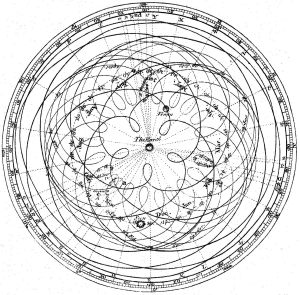
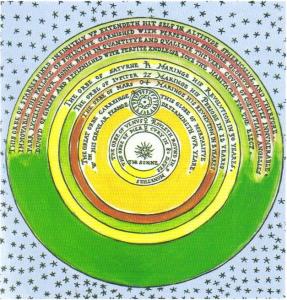
True technical simplification arrived with Kepler. By abandoning the Greek ideal of perfect circles and accepting elliptical orbits, epicycles became unnecessary. Kepler’s three laws replaced the entire epicycle system. This breakthrough flowed from his theological conviction: “The actual design of God (ellipses) is superior to human imaginings of perfection (circles). Theory must submit to God’s real creation, not to philosophical presuppositions” (Kepler, Astronomia Nova, Introduction; Harmonices Mundi, Book IV).
The progression from Ptolemy to Copernicus and then to Kepler reveals the true nature of the Scientific Revolution: it was not a merely technical advance from “more than eighty circles” to “zero circles,” but a worldview breakthrough—from the Greek philosophical veneration of the “perfect circle” to an empirical submission grounded in biblical creationism. Copernicus challenged the presupposition of geocentrism, but he did not challenge the presupposition of circular motion. Only Kepler, guided by the biblical principle of ordered contingency, fully cast off the constraints of Greek philosophy, allowing observation to take precedence over rational speculation. This alone constituted a genuine return to a biblical scientific method. Neither humanity, nor the Earth, nor even the Sun is the center of the universe—God alone is.
IV. Galileo’s Weapon: The “Two Books” Overturn Celestial Perfection
Galileo Galilei (1564–1642), an Italian Catholic, improved the telescope in 1609. Between 1610 and 1613 he discovered Jupiter’s four largest moons, the mountains of the Moon, and the phases of Venus. In 1632 he published Dialogue Concerning the Two Chief World Systems, and in 1638 he laid the foundations of kinematics. He is acclaimed as “the father of modern science, modern physics, and observational astronomy.”
1. Galileo’s Christian Faith and Scientific Motivation
Galileo is often portrayed in secular narratives as an “anti-religious martyr.” The historical truth, however, is that his scientific work was fundamentally a practical outworking of a theological vocation. Galileo understood scientific investigation as reading “God’s second book”—that is, general revelation. In his Letter to the Grand Duchess Christina, he repeatedly emphasized the harmony between Scripture and nature, writing that “Scripture and Nature alike proceed from the divine word,” and that “Nature precisely executes the laws imposed by God, never violating them” (Galileo Galilei, Letter to the Grand Duchess Christina [1615], in Discoveries and Opinions of Galileo, trans. Stillman Drake, 175, 182). He also cited the early Church Father Tertullian: “We first know God through nature, and then more fully through doctrine” (ibid., 175–216).
2. Telescopic Observations: Overthrowing the Greek Doctrine of Celestial Perfection
Aristotle’s “hierarchical cosmos” posited that the sublunary sphere consists of the four elements—earth, water, air, and fire—subject to change, decay, and impermanence, with motion being linear (having a beginning and an end, tending toward its natural place: earth and water toward the universe’s center, air and fire away from it). The supralunar realm, by contrast, consisted of the incorruptible, immutable “fifth element,” aether, whose pure matter necessarily moved in perfect circular motion (beginningless, eternal, symmetrical, uniform). This teaching was absorbed by the medieval Roman Catholic Church and became scholastic orthodoxy. Consequently, the notion that “the heavens must be perfectly smooth” was not merely a scientific hypothesis but a non-biblical philosophical-theological dogma.
Galileo’s shocking “heretical” observations directly overturned this view:
- “The Moon is not a smooth sphere but rugged, full of enormous prominences, deep valleys, and crevices… much like the Earth’s surface” (Galileo Galilei, Sidereus Nuncius [Venice, 1610], 8–10). He even calculated the height of lunar mountains (about four miles), demonstrating that celestial bodies are composed of the same material as Earth.
- Jupiter’s four moons (later called the “Galilean satellites”) orbit Jupiter, forming a “miniature solar system,” proving that Earth is not the unique center of motion and that celestial bodies can revolve around non-Earth centers, supporting the Copernican hypothesis.
- Venus exhibits a full sequence of phases, from new to full, possible only if it orbits the Sun—direct evidence for heliocentrism (Galileo Galilei, Letters on Sunspots [Rome, 1613]).
Galileo’s telescopic observations marked a fundamental shift in scientific methodology: truth is not derived from philosophical deduction but from observation of the created world. The theological foundation of this shift lies in the biblical doctrine of creation and its principle of “ordered contingency”: if the world were necessary, as Greek philosophy supposed, one could deduce its nature through reason alone (e.g., “the heavens must be perfect”); if the world is freely created by God, one must determine God’s actual design through observation (e.g., “the Moon really has mountains”).
Galileo wrote: “Natural philosophy is not learned from reading Aristotle’s books, but from reading that great book which ever lies open before our eyes—the universe itself” (Stillman Drake, Galileo at Work: His Scientific Biography [Chicago: University of Chicago Press, 1978], 163). This expresses a biblical epistemology: the created world is God’s “second book,” authoritative and to be seriously “read” (observed) rather than distorted by human philosophical preconceptions.
3. The Inclined Plane Experiment: Overthrowing Aristotelian “Essence Theory”
Aristotle’s theory of “natural motion” held that heavier bodies fall faster than lighter ones (“a stone falls faster because it is heavy”), with velocity proportional to the object’s “essential weight.” This “law of nature” required no experimental verification and dominated thought for nearly 2,000 years because it “made sense” to ordinary experience (feathers fall more slowly than stones).
Galileo first exposed the logical contradiction of Aristotle’s theory through a thought experiment: “Suppose a heavy stone falls at speed 8 and a light stone at speed 4. If they are tied together, Aristotle would predict the light stone slows the heavy one, giving a speed less than 8; yet by Aristotle’s other principle, the combined weight should fall faster than 8. Contradiction! Therefore, Aristotle’s premises must be wrong” (Galileo Galilei, Dialogue Concerning the Two Chief World Systems [Florence, 1632], Day 1). He then confirmed this experimentally: spheres of different weights released from the same height simultaneously reach the bottom (ignoring air resistance), showing that fall time depends not on weight but on height and acceleration.
Why did Galileo dare challenge authority experimentally? Because of his theological presuppositions:
- The created world possesses independent authority: “Nature never violates its laws… it cares nothing whether human reasoning approves” (Galileo Galilei, Letter to the Grand Duchess Christina [1615], in Discoveries and Opinions of Galileo, 175–216). If nature is God’s creation, it contains objective truth independent of human opinion. Experimentation is not “questioning God” but “submitting to God’s revelation.”
- God may design differently than human notions of perfection: Aristotle erred in equating human rational reasoning with natural truth. Galileo maintained: “God can create the world in ways unexpected by us; therefore we must humbly observe rather than arrogantly speculate” (ibid.). This expresses the principle of ordered contingency: the world is not rationally necessary but freely created by God; hence empirical observation takes precedence over philosophical deduction.
4. The Truth of the Galileo Affair: Not “Science vs. Religion” but “Empiricism vs. Philosophy”
Popular culture often depicts Galileo as a “science martyr persecuted by religion.” The historical truth is:
- The core conflict was not Scripture but Aristotelian philosophy. Galileo’s primary opponents were scholastics committed to Aristotle, especially conservative Jesuits and Dominicans. These scholars linked Aristotle’s cosmos to biblical interpretation, believing that challenging the former equaled challenging the latter (James Hannam, God’s Philosophers, 284–99). Pope Urban VIII had been friendly toward Galileo, allowing in 1624 discussion of heliocentrism as a hypothesis. Galileo’s trial resulted from his arrogance and political missteps: in the Dialogue he presented heliocentrism as fact, not hypothesis, and mocked the Pope, provoking censure.
- The real conflict was a clash of scientific paradigms: as Thomas Kuhn notes, “The Galileo affair is essentially a paradigmatic case of the Scientific Revolution—where the new paradigm (empiricism, mathematical physics) challenges the old (scholasticism, essence theory), and entrenched powers (Aristotelians within the Roman Church) resist the change using institutional authority” (Thomas S. Kuhn, The Copernican Revolution, 219–25).
Plato-Aristotle tradition held that truth resides in the “world of Forms” or “Essences,” while sensory observation only grasps appearances and is unreliable; hence, reason supersedes experience. If Galileo had accepted Aristotle’s skepticism of the senses, lunar mountains under the telescope would have been “optical illusions,” Venus’ phases explained via more complex epicycles, and Aristotle’s authority would trump observation. Galileo insisted on observation first, grounded in two theological presuppositions:
- God does not deceive our senses: “God gave us senses, reason, and intellect… He does not allow our senses to deceive us, then require reason to correct them, only to declare reason wrong” (Galileo Galilei, Letter to the Grand Duchess Christina, 175–216). This is an epistemological corollary of the imago Dei: humans are created in God’s image, so God-given senses are reliable when used properly.
- The created world is God’s “second revelation,” authoritative: “Nature is God’s work, Scripture is God’s word. But nature never violates its laws, whereas human interpretation may err” (ibid.). This legitimizes interpreting the “book of nature” in light of Scripture: when clear natural evidence conflicts with traditional exegesis, exegesis must be corrected rather than denying the evidence.
Without these two presuppositions, Galileo might have interpreted telescopic observations conservatively (“optical illusion,” “atmospheric refraction”) rather than drawing revolutionary conclusions (imperfect heavens); like many contemporaries, he could have abandoned heliocentrism under Church pressure. Secularizing science from faith would not have motivated his Letter to Christina. Contemporary Jesuit astronomer Christoph Scheiner observed the same sunspots but insisted they were “shadows of small planets,” because he could not accept an imperfect Sun (Christoph Scheiner, Rosa Ursina, 1626–1630).
5. Galileo’s Contribution: Three Revolutions in Scientific Methodology
Galileo’s contribution was not only specific discoveries but three methodological revolutions:
- Observation over authority: “In natural science, the authority of a thousand Democrituses is not worth the reasoning of any lowly individual if he can give a better explanation” (Galileo Galilei, Letter to Ingoli, 1624).
- Mathematics as the language of nature: “Philosophy [i.e., natural philosophy/physics] is written in that great book which ever lies open before our eyes… written in the language of mathematics, whose characters are triangles, circles, and other geometric figures” (Galileo Galilei, The Assayer, 1623).
- Experiment as interrogation of nature: Galileo’s inclined plane experiments were not passive observation but actively designed conditions to “question” natural laws. This reflects the “dominion mandate” (Gen. 1:28): humans have the authority to study and test creation because it is divinely assigned.
Historian Alexandre Koyré summarizes: “Galileo is not only the founder of modern science but also the founder of the modern scientific worldview. He provided legitimacy to empirical method through the theology of the ‘two books,’ confidence for human reason through the imago Dei, and stability for natural laws through the doctrine of providence. It is the combination of these three that forms the true foundation of modern science” (Alexandre Koyré, Galileo Studies, trans. John Mepham, 205–7).
The Galileo affair reveals a deeper issue: who has the authority to interpret Scripture regarding natural phenomena? Scholastic tradition held that the Roman Church possessed sole interpretive authority, maintaining Scripture’s literal meaning (e.g., Joshua 10:12–13, “the Sun stood still”), hence heliocentrism was seen as contrary to Scripture. Galileo’s hermeneutical principle was that Scripture’s purpose is “to teach men how to go to heaven, not how heaven goes.” It employs phenomenal language (e.g., “sunrise”) to accommodate common understanding, not as a scientific textbook; when literal interpretation conflicts with clear natural evidence, non-literal interpretation should prevail (e.g., Psalm 119:90, “You established the Earth” does not imply geocentrism). Therefore, the Galileo affair was not religion obstructing science but human tradition usurping Scripture. As Van Til observes: “The Galileo affair demonstrates that it was not ‘Scripture against science,’ but ‘erroneous interpretation of Scripture against correct observation of nature.’ Only a return to Scripture itself—rather than Roman Catholic tradition—can provide true freedom for science” (Van Til, Christian Apologetics, 124).
V. Kepler’s Obedience: Listening to God’s Cosmic Symphony
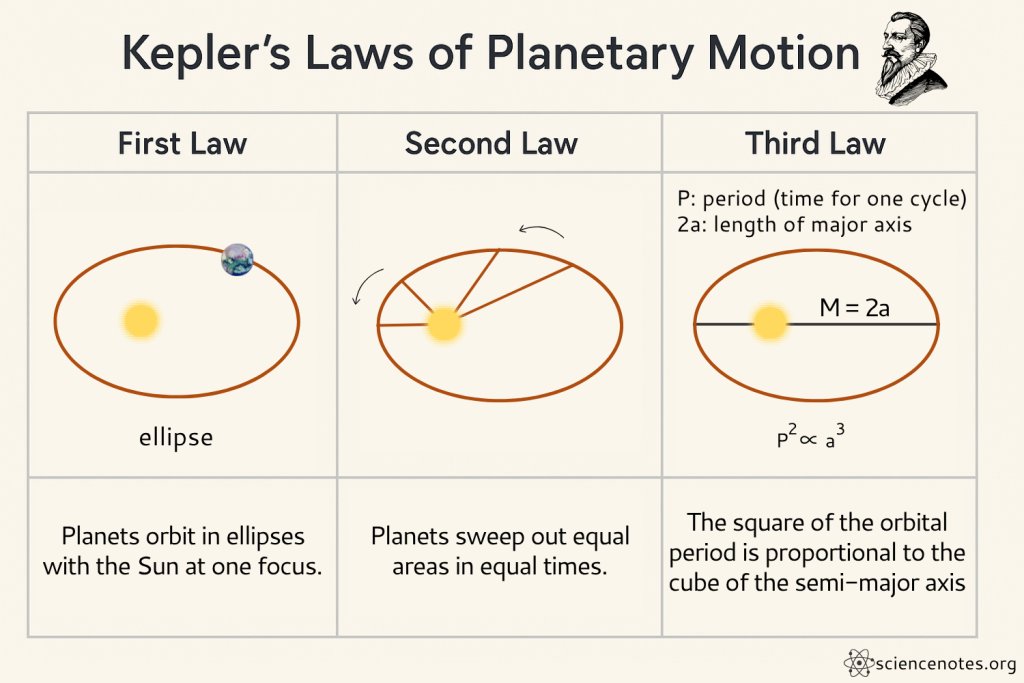
Johannes Kepler (1571–1630), German, Lutheran. In 1609, he discovered the first and second laws of planetary motion (elliptical orbit and area law), published in Astronomia Nova (The New Astronomy). In 1619, he discovered the third law of planetary motion (the harmonic law, T² ∝ a³), published in Harmonices Mundi (The Harmony of the World). In 1619, he discovered the theory of celestial music, translating planetary velocity ratios into musical intervals. He is known as the “Father of Celestial Mechanics.”
1. From Data to Laws: A Mission Impossible
Modern popular culture often overlooks a remarkable fact: Kepler’s extraction of the three laws of planetary motion from Danish astronomer Tycho Brahe’s (1546–1601) observational data was an “almost impossible” feat, both mathematically and philosophically.
Although Tycho’s observational data had already reached the limit of the naked eye (accurate to about 2 arc minutes), it still contained: atmospheric refraction errors, systematic instrument errors, complex superimposed effects of Earth’s rotation and revolution, and minor perturbations from other planets’ gravity (whose existence was unknown at the time). Without the correct theoretical framework presupposed, these data were just a pile of chaotic numbers. Kepler needed to identify the signal within the noise, without even knowing the shape of the signal. If one were to fit the laws of motion from observational data, the space of possibilities was astronomically large:
- Possibilities for orbital shape: Circles and their variants (eccentric circles, concentric circles, multiple circles), ellipses (different eccentricities, different focal positions), ovoid curves (which Kepler himself attempted), higher-order curves (parabolas, hyperbolas, spirals, cycloids, etc.). There were >10⁴ possible types of orbital shapes.
- Possibilities for velocity laws: Uniform velocity? Related to distance (proportional, inversely proportional, squared, square root…)? Related to angle (sine, cosine, tangent…)? Related to time? Related to area (this is the correct answer, but extremely unintuitive)? Multi-variable combinations? There were >10⁴ possible velocity laws.
- Possibilities for period relationships: T ∝ a (linear), T ∝ a², T² ∝ a³ (the correct answer), T³ ∝ a², T ∝ √a, combinations involving eccentricity, mass, and other parameters. There were >10⁴ possible period relationships.
If Kepler’s discovery process is viewed as “randomly trying all possible theoretical combinations,” the total possibility space is at least 10⁴ × 10⁴ × 10⁴ = 10¹² possible theoretical combinations. Even if each attempt required only 1 day to verify, an exhaustive search would require: 10¹² days ≈ 2.7 billion years. This is still under the ideal condition that every possibility could be clearly defined and quickly tested; in reality, most combinations would require complex geometric constructions and tedious numerical calculations. This helps us understand the enormity of Kepler’s task. Tycho himself possessed this data for 20 years (1576–1597) but failed to discover any laws. Contemporary astronomers such as Longomontanus (Tycho’s chief assistant) and Maestlin (Kepler’s teacher) also used similar data but remained trapped in the “circular orbit” framework. Longomontanus even continued using this data for 30 years after Tycho’s death, publishing Astronomia Danica, still employing a complex epicycle system. Why did only Kepler succeed? Science historian James Voelkel commented: “Without Kepler’s unique theological-mathematical worldview, he could not have found his way out of the labyrinth of data. His success was not a ‘replicable method’ but an ‘arrangement of Providence’—the right person, at the right time, with the right beliefs, facing the right data” (James R. Voelkel, Johannes Kepler and the New Astronomy [Oxford: Oxford University Press, 1999], 123).
2. Kepler’s “Theological Compass”: How Biblical Presuppositions Guided Discovery
Kepler’s success was not through exhaustive enumeration but through inspiration; not a technical victory of data analysis but a result of a biblical worldview. His biblical presuppositions provided threefold navigation for exploration:
(1) Theological Presupposition One: God’s Design Must Be Simple and Harmonious
Kepler wrote in Mysterium Cosmographicum: “God is a geometer. He created the universe according to geometric principles; therefore, the structure of the universe must necessarily embody mathematical simplicity and harmony” (Johannes Kepler, Mysterium Cosmographicum [Tübingen, 1596], Preface). This belief enabled him to:
- Reject the Ptolemaic system’s more than 80 epicycles because they were too complex, “unworthy of God’s wisdom.”
- Reject his own early design of “ovoid orbits,” which, although they could fit the data, had ugly mathematical expressions (Johannes Kepler, Astronomia Nova [Prague, 1609], Chapters 40–45).
- Finally accept the ellipse—simple, elegant, and the Sun’s position at the focus had theological significance: “The Sun at the focus is like the Father in the glorious position of the universe.”
The principle of simplicity reduced the 10⁴ orbital shapes to approximately 10² mathematically elegant options (the conic section family). Without the presupposition that “God is a God of order,” Kepler might have been lost among countless complex curves that could fit the data.
(2) Theological Presupposition Two: God’s Creation Must Be Known Through Observation
The belief in “contingent rationality”—that “God creates freely, and humans cannot deduce by reason but must observe”—enabled Kepler to dare to question the 2,000-year tradition of “circular perfection,” insisting on “making theory submit to data” rather than the reverse. He refused to ignore the 8 arc minute deviation between Tycho’s data and circular orbit theory. Kepler discovered that, according to circular orbit theory, no matter how circles were combined, there was always a tiny error of 8 arc minutes (about 0.13 degrees) between the calculated position of Mars and Tycho’s observational data. To eliminate these 8 arc minutes, Kepler abandoned the perfect circle, tried the ellipse, and found that the model perfectly matched the data. He wrote: “God gave us an observer as precise as Tycho Brahe; we must acknowledge God’s gift. If I ignore this 8 arc minute deviation, I am ignoring what God is saying to me through Tycho” (Johannes Kepler, Astronomia Nova [Prague, 1609], Introduction).
The principle of empirical priority excluded all “philosophically necessary models” (such as “perfect circles”) that contradicted observation, reducing velocity laws to the order of 10¹. This attitude was extremely rare at the time; contemporary scholars would rather modify data or add small epicycles than abandon circular orbits, because Aristotelian philosophy held that the heavens must necessarily be perfect.
(3) Theological Presupposition Three: God’s Providence Guarantees the Stability and Universality of Laws
Kepler’s third law revealed the unified relationship between the periods and orbits of all planets. This discovery was based on his belief: “God created all planets with the same wisdom; therefore, there must be a unified mathematical law running through them” (Johannes Kepler, Harmonices Mundi [Linz, 1619], Book V, ch. 3. English translation: The Harmony of the World, trans. E.J. Aiton, A.M. Duncan, and J.V. Field [Philadelphia: American Philosophical Society, 1997]).
The principle of universal laws guided him to seek relationships applicable to all planets rather than building independent models for each planet. This reduced the search space for velocity laws and period relationships to the order of 10². If Kepler had believed that each planet was governed by a different god (polytheism), or that the universe had no unified order (occasionalism), he would not have sought “universal laws” at all.
Kepler obtained Tycho’s data in 1600, published Astronomia Nova (containing the first and second laws) in 1609, and discovered the third law in 1619—a total of approximately 9 years. Because Kepler’s threefold theological presuppositions “optimized” the search algorithm, the search space decreased from 10¹² combinations to 10⁴ possibilities. If each attempt required 1 day, the total would be 10⁴ days ≈ 27 years. Even considering Kepler’s inspiration, mathematical genius, the fact that some attempts could be excluded through logical reasoning (without complete calculation), and the high quality of Tycho’s data (reducing noise interference), this was still an enormous workload.
Academic commentary on this includes:
- Philosopher of science Michael Polanyi pointed out: “Scientific discovery is never an automatic process of ‘data induction’ but requires guidance from a ‘presuppositional framework.’ Kepler’s success proves that the correct worldview is not only helpful for science but is a necessary condition for the birth of science” (Michael Polanyi, Personal Knowledge: Towards a Post-Critical Philosophy [Chicago: University of Chicago Press, 1958], 6–7, 143).
- Science historian Owen Gingerich further noted: “Kepler spent nearly ten years trying various orbital models—including ovoids of his own invention—before finally accepting the ellipse. Had he given up midway (like other astronomers), or had he clung to the circular dogma (like Tycho), the birth of modern astronomy would have been delayed by decades or even centuries. His success was not inevitable but a unique combination of theological conviction and scientific talent” (Owen Gingerich, The Eye of Heaven: Ptolemy, Copernicus, Kepler [New York: American Institute of Physics, 1993], 305, 308–310).
- Science revolution historian Bernard Cohen concluded: “The discovery of Kepler’s laws is the best case in the history of science of ‘theory preceding observation.’ Without correct theoretical expectation (provided by theology), the observer will drown in a sea of data” (I. Bernard Cohen, Revolution in Science [Cambridge, MA: Harvard University Press, 1985], 136).
3. Celestial Music: Describing Planetary Motion with Staff Notation
In the preface to Harmonices Mundi, Kepler quoted Job 38:7: “When the morning stars sang together, and all the sons of God shouted for joy,” believing this to be a prophecy of God’s creation of cosmic harmony (Johannes Kepler, Harmonices Mundi [Linz, 1619], Proemium. English translation: The Harmony of the World, trans. E.J. Aiton, A.M. Duncan, and J.V. Field [Philadelphia: American Philosophical Society, 1997]).
In Book V of Harmonices Mundi, he drew the “musical melodies” of the six planets, using the following method:
- Step One: Calculate angular velocity changes from elliptical orbits
- According to the second law (area law), the closer a planet is to the Sun, the faster it moves.
- Kepler calculated the ratio of angular velocities for each planet at “perihelion” (fastest) and “aphelion” (slowest).
- Step Two: Convert angular velocity ratios into musical intervals
- Saturn: perihelion/aphelion velocity ratio ≈ 5:4 (major third).
- Jupiter: ≈ 6:5 (minor third).
- Mars: ≈ 3:2 (perfect fifth).
- Earth: ≈ 16:15 (semitone).
- Venus: ≈ 25:24 (extremely small semitone).
- Mercury: ≈ 12:5 (octave + minor third).
- Step Three: Draw staff notation. Kepler actually drew “melodic lines” for the six planets in his book:
- Saturn sings a “deep major third.”
- Jupiter sings a “solemn minor third.”
- Mars sings an “impassioned perfect fifth” (greatest variation).
- Earth sings a “faint semitone” (nearly circular orbit).
- Venus sings an “almost monotonous tone” (closest to circular).
- Mercury sings a “leaping octave” (greatest eccentricity).
He wrote: “These melodies are not coincidental but the harmony ‘composed’ by God at creation. Each planet is like a musician in an orchestra, singing according to the part God assigned… I am merely ‘transcribing’ this eternal song” (Johannes Kepler, Harmonices Mundi [Linz, 1619], Book V, ch. 7. English translation: The Harmony of the World, trans. E.J. Aiton, A.M. Duncan, and J.V. Field [Philadelphia: American Philosophical Society, 1997]).
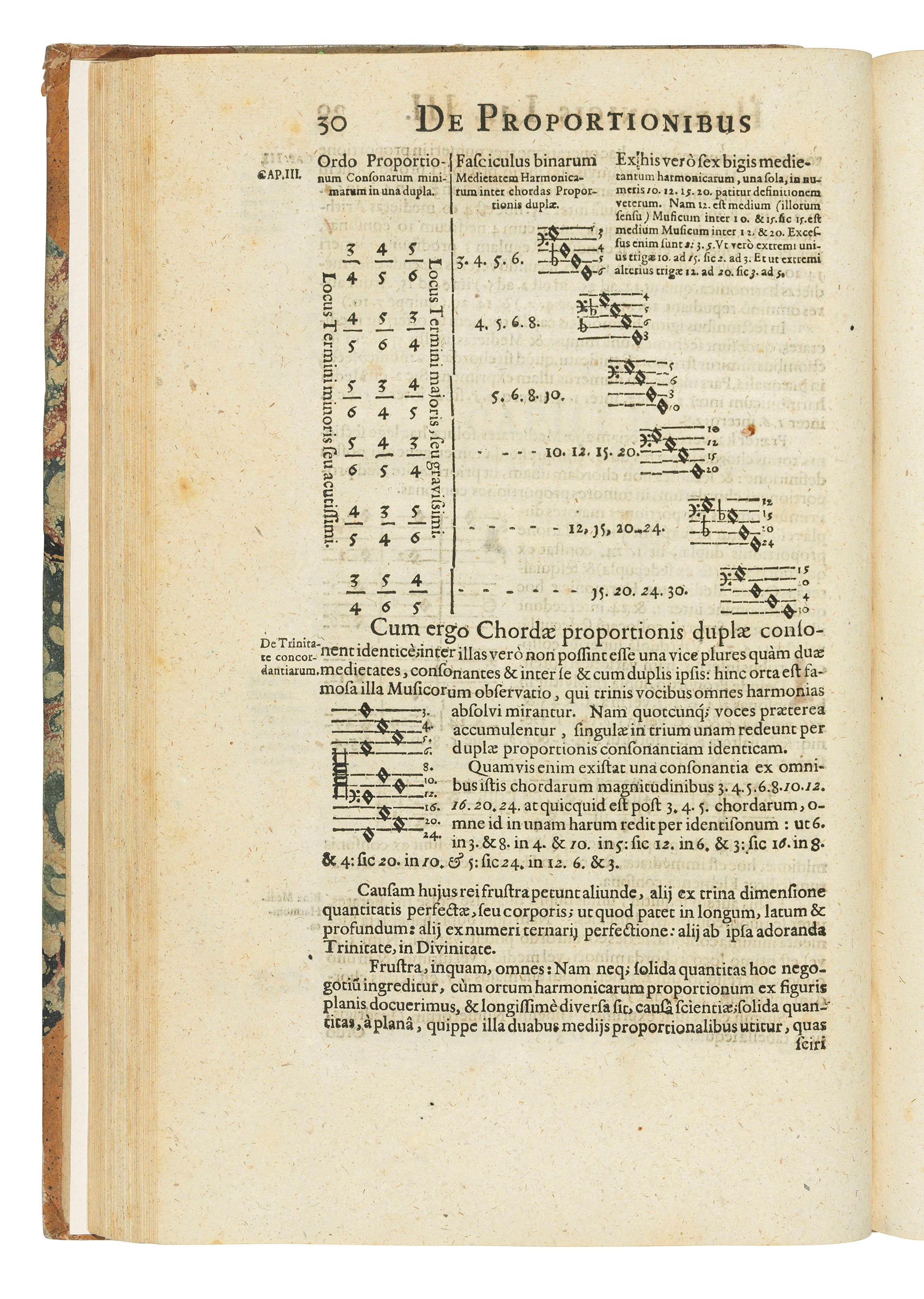
Kepler’s theory of celestial music was not a mathematical game but an embodiment of three major theological beliefs:
- God is a musician: “God used harmonic principles in creation, just as a composer uses intervals to create a symphony. He did not randomly arrange planetary orbits but designed the entire universe according to ‘the mathematics of music’ (harmonic proportions)” (Johannes Kepler, Harmonices Mundi [Linz, 1619], Book V, ch. 3. English translation: The Harmony of the World, trans. E.J. Aiton, A.M. Duncan, and J.V. Field [Philadelphia: American Philosophical Society, 1997]). This belief originated from Proverbs 8:27–30: “When he established the heavens… when he drew a circle on the face of the deep… Then I was beside him, like a master workman… delighting in him.” Kepler believed that “Wisdom” was God’s “musical principle,” and the universe was “composed” according to this principle.
- Musical proportions reflect the nature of the Trinity: Kepler compared the three elements of music (1. melody, 2. harmony, 3. rhythm) to the Trinity (1. Father, 2. Son, 3. Holy Spirit): The Father is the single melody (Unison), as the Sun is the center of the universe; the Son is harmony, as the proportional relationships among planets; the Holy Spirit is rhythm, as the “sweeping speed” of the second law. He wrote: “The trinitarian structure of music is not a human invention but an imprint of God’s nature. The universe must be musical because it is the work of the Triune God” (Johannes Kepler, Harmonices Mundi [Linz, 1619], Book III, ch. 2).
- Humans can “hear” cosmic music because they are made in God’s image: Kepler quoted Psalm 19:1–4: “The heavens declare the glory of God… There is no speech, nor are there words, whose voice is not heard… Their voice goes out through all the earth,” believing that the universe’s “music” is not physical sound waves (which no one can hear) but mathematical harmony, requiring reason to “hear.” “God gave humans reason and musical sense so that we can ‘hear’ His harmony in the elliptical orbits of planets. This is proof of the doctrine of the image: the human mind is connected with God’s mind” (Johannes Kepler, Harmonices Mundi [Linz, 1619], Book V, ch. 9. English translation: The Harmony of the World, trans. E.J. Aiton, A.M. Duncan, and J.V. Field [Philadelphia: American Philosophical Society, 1997]).
Kepler’s staff notation was not a supplement to the three laws but their motivation and explanatory framework:
- First Law (elliptical orbits): Planetary orbits are not perfect circles because God’s “composition” is not limited by human notions of “perfection.” Ellipses make velocity variation possible, thus producing melody.
- Second Law (area law): The law of velocity variation (equal area/equal time) ensures stable rhythm in the melody. Without the second law, planetary motion would be lawless noise. Modern astronomy confirms that planetary velocity ratios do indeed approximate musical intervals. Astronomers have discovered that during planetary system formation, gravitational resonance produces “interval locking” phenomena, causing orbital ratios to tend toward simple fractions (such as the 5:2 resonance between Jupiter and Saturn).
- Third Law (T² ∝ a³): All planets’ periods and orbital sizes follow the same mathematical relationship, which is proof that different parts (planets) belong to the same symphony (solar system).
If Kepler had been purely a “rationalist,” he might have been satisfied with the first two laws. It was the theological belief that “the universe must have unified harmony” that drove him to continue seeking “the unified relationship among all planets” (the third law). When Kepler discovered the third law (May 15, 1618), he wrote in his diary: “I have found it! The ‘General Score’ God used at creation! All parts (planets) are arranged according to the same harmonic principle (T² ∝ a³). Hallelujah!” (Johannes Kepler, personal diary, May 15, 1618, quoted in Max Caspar, Kepler [New York: Dover, 1993], 288).
Science historian Owen Gingerich commented: “Kepler’s theory of celestial music appears to modern scientists as ‘mysticism,’ but it was precisely this ‘mysticism’ (actually theological conviction) that drove him to search for hidden mathematical patterns in the data. Without this conviction, the third law might never have been discovered” (Owen Gingerich, The Eye of Heaven: Ptolemy, Copernicus, Kepler [New York: American Institute of Physics, 1993], 312).
Philosopher of science Gerald Holton pointed out: “Kepler’s case reveals that scientific discovery often stems from ‘non-rational’ (actually super-rational) beliefs—beauty, harmony, unity. These beliefs themselves cannot be proven scientifically, yet they are the driving force of scientific exploration. For Kepler, the source of these beliefs was theology” (Gerald Holton, Thematic Origins of Scientific Thought [Cambridge, MA: Harvard University Press, 1988], 69–71).
4. Kepler’s Laws Are Products of the Biblical Worldview
Van Til pointed out: “All knowledge activities presuppose some ‘ultimate interpretive framework.’ Kepler’s success reveals that the biblical doctrine of creation-providence is not only a theological doctrine but also a necessary condition for scientific knowledge. If the universe were not created and faithfully maintained by a rational God, ‘seeking laws’ itself would be a meaningless activity” (Van Til, Christian Apologetics, 118). Kepler himself clearly expressed this epistemological position in his prayer at the end of Harmonices Mundi: “O Lord, if I have been seduced into presumptuousness by the wonderful beauty of Your works, or if I have pursued my own glory among men while furthering work meant for Your glory, gently and mercifully forgive me. Behold, I have here completed the work of glorifying Your handiwork in this book, to the extent my finite mind could comprehend… My whole mind strives to proclaim Your glory” (Johannes Kepler, Harmonices Mundi [Linz, 1619], Book V, ch. 9. English translation: The Harmony of the World, trans. E.J. Aiton, A.M. Duncan, and J.V. Field [Philadelphia: American Philosophical Society, 1997]).
Therefore, the discovery of Kepler’s laws was not accidental fortune but a product of the biblical worldview. In God’s providence, the right person (Kepler with mathematical talent and theological convictions), the right data (Tycho’s precise observations), and the right era (intellectual liberation after the Reformation) together testified that “the heavens declare the glory of God” (Psalm 19:1), not only in the beauty of creation but also in the human process of knowing creation.
5. Kepler’s Laws’ Decisive Role for Newton
The world did not immediately celebrate Kepler’s discoveries; on the contrary, Kepler’s laws were long met with indifference because:
- Lack of physical mechanism: Although Kepler described “how it moves,” he could not explain “why it moves this way.” He himself tried to explain it with magnetism or “the soul of the Sun,” which sounded like pseudoscience.
- Mathematics too complex: For contemporaries accustomed to circular motion, calculating elliptical orbits was too cumbersome.
- Galileo’s disregard: Kepler’s correspondent Galileo insisted on the aesthetics of uniform circular motion until his death, completely ignoring Kepler’s elliptical theory and mathematical derivations.
- Descartes’ disregard: Contemporary René Descartes (1596-1650) attempted to establish a purely mechanical, logical universe model without any mystical elements, refusing to accept Kepler’s “ellipse pieced together from data, driven by mysterious magnetism, with varying speeds.”
One year after Kepler’s death, people successively observed the transit of Mercury and Venus according to predictions from his Rudolphine Tables, gradually believing in ellipses, but few accepted his physics-based view of celestial motion. It was not until 1687, when Newton rigorously derived Kepler’s three laws from the force-based law of universal gravitation in Philosophiæ Naturalis Principia Mathematica, that Kepler’s laws were thoroughly accepted.
Kepler’s laws were not merely “helpful” to Newton’s law of universal gravitation but logically indispensable prerequisites. Without Kepler’s laws, there would be no law of universal gravitation. If not for Kepler, Newton might have developed terrestrial mechanics but could not have achieved “the unification of heaven and earth.” And it was precisely this unification that marked the birth of modern science. Newton explicitly acknowledged his derivation from Kepler’s laws in the Principia (Isaac Newton, Philosophiæ Naturalis Principia Mathematica, 3rd ed. [London, 1726], Book I, Proposition 1).
- The First Law (elliptical orbits) derived that gravity points toward the focus: If planets moved in circular orbits, the center of force could be at the circle’s center or at other positions (such as Ptolemy’s “eccentric circle”). But the mathematical properties of elliptical orbits determine that force must point toward one of the foci. Newton derived from this geometric constraint that the source of gravity must be the Sun (at the focal position). If Kepler had not discovered elliptical orbits, even if Newton had guessed that gravity existed, he could not have determined its direction. In 1684, Halley (Edmond Halley, 1656-1742) visited Newton at Cambridge and asked a question that had puzzled scholars: “If gravity is inversely proportional to the square of distance, what shape is a planet’s orbit?” Newton replied: “It’s an ellipse. I calculated it before but lost the paper. I’ll calculate it again for you.” Halley was greatly impressed and urged Newton to write these theories into a book, helping to publish it at his own expense. In 1687, Philosophiæ Naturalis Principia Mathematica was published.
- The Second Law (area law) derived the radial nature of gravity: “The line connecting a planet and the Sun sweeps equal areas in equal times”—this law, expressed in modern physics, is conservation of angular momentum. This implies crucial information: the force acting on the planet has no tangential component, only a radial component. Newton proved in Book I, Proposition 1 of the Principia: “The area law holds if and only if the force points toward the center” (Isaac Newton, Philosophiæ Naturalis Principia Mathematica, 3rd ed. [London, 1726], Book I, Proposition 1). This proof excluded all possibilities of “non-central forces,” narrowing the search range from infinite types to “central forces.”
- The Third Law (T² ∝ a³) derived the inverse-square law: Kepler’s third law provided the most crucial clue. Newton proved through mathematical derivation that for circular motion, centripetal force F ∝ v²/r. From T² ∝ a³, one can derive v² ∝ 1/r, therefore F ∝ 1/r². This is the inverse-square law of universal gravitation. If Kepler had not discovered the third law, Newton might have guessed that “gravity is related to distance” but could not have determined whether it was 1/r, 1/r², 1/r³, or some other functional form.
Without Kepler’s laws, universal gravitation could only remain at the “conjecture” stage. Newton wrote in Book III of the Principia, “Rules of Reasoning in Philosophy”: “We must acknowledge that effects of nature that are consistent and constant should be attributed to the same cause. The universality of Kepler’s laws proves that the force governing planetary motion and the force causing apples to fall must be the same force” (Isaac Newton, Principia, Book III, Rules of Reasoning, Rule 2).
Science historian Bernard Cohen analyzed the argumentative structure of the Principia and found: Book I (laws of motion) 20% depends on Kepler’s laws, Book II (resistance of media) 5% depends on Kepler’s laws, Book III (universal gravitation) 80% of propositions use Kepler’s laws as premises. Cohen’s conclusion is that “without Kepler’s three laws, the core content of Newton’s Principia—celestial mechanics—could not have been established at all” (I. Bernard Cohen, The Newtonian Revolution [Cambridge: Cambridge University Press, 1980], 78–80).
VI. Boyle’s Piety: Experimental Chemistry Brings Greek Essentialism to an End
Robert Boyle (1627–1691) was Anglo-Irish, a communicant of the Church of England, and came of age during the Puritan Revolution and the period of Cromwellian rule (1642–1660), being profoundly shaped by Puritan thought. In 1661 he published “The Sceptical Chymist”; in 1662 he formulated what is now known as Boyle’s Law; and he is acclaimed as the “Father of Modern Chemistry.” His scientific work was built directly upon the Puritan systematic theology of human nature: because human reason is finite and fallen, we cannot arrogantly construct systems but must humbly observe God’s creation through experiment.
1. Overthrowing Greek Essentialism: Experiment over Philosophical Speculation
In 1659, the wealthy aristocrat Boyle supplied the funding and the ideas, while his impoverished assistant Robert Hooke (1635–1703) provided the labor and technical expertise. Together they completed the costly air-pump experiments, demonstrating that a genuine vacuum exists and thereby overthrowing Aristotle’s essentialist axiom that “nature abhors a vacuum.” The experiments showed that air is elastic and that pressure varies inversely with volume. This was a triumph of biblical methodology: Boyle observed that through these experiments we can see how God’s providence faithfully maintains order (Robert Boyle, “New Experiments Physico-Mechanical” [Oxford, 1660], Preface), reflecting how God’s faithful covenant (Gen. 8:22) guarantees experimental repeatability — rather than the determinism of Greek philosophy.
Greek essentialism (Aristotle) held that the behavior of matter derives from an inner “essence” (e.g., a stone falls because it possesses the essence of heaviness). This view led to circular reasoning and discouraged experimentation. In “The Sceptical Chymist,” Boyle criticized this position not only on chemical but on theological grounds:
- Boyle opposed Greek rationalism, which held natural laws to be logically necessary. He maintained that natural laws are entirely contingent upon God’s free will. God could have created any form of world; therefore, human beings cannot retreat into their studies and deduce nature by logic alone (that was the arrogance of the Greeks) but must enter the laboratory and observe what God has in fact done.
- Deeply influenced by Calvinism, Boyle was firmly convinced that human intellect had been impaired by Adam’s Fall. Human reason is therefore unreliable and prone to fantasy. Experiment is not merely a scientific method but a spiritual discipline, compelling proud human reason to submit before the objective facts of God’s creation. Experimentation is the only humble path by which fallen humanity can rebuild knowledge.
2. Leviathan and the Air-Pump: Hobbes, Boyle, and the Experimental Life
“Leviathan and the Air-Pump: Hobbes, Boyle, and the Experimental Life” is a 1985 work in the history of science by Steven Shapin and Simon Schaffer. By analyzing the dispute between Thomas Hobbes (1588–1679) and Boyle over the air pump and the vacuum, the authors advance a provocative thesis: the establishment of scientific methodology in the seventeenth century — and in particular the spread of the experimental method — was not a purely scientific choice, but also a political and social one.
Hobbes was a political philosopher and the author of “Leviathan.” His epistemological stance was rational deduction: truth, he believed, should be derived through reason and geometrical demonstration, not through experiment. Boyle was an experimental scientist and a founding figure of the Royal Society, whose epistemological stance was experimental induction: truth, he held, should be arrived at through observation, experiment, and witnessed testimony. Hobbes categorically rejected the air-pump experiments for three reasons:
- Hobbes denied the vacuum: his material philosophy did not permit non-material space. He maintained that Boyle’s pump had merely removed the air, but that the vessel remained filled with some invisible “aether.”
- Hobbes championed “geometrical deduction” in matters of knowledge. He argued that experimental results could be manipulated, that they depended on a complex machine, and that only a small number of people could assemble in a laboratory to witness them — making the method unreliable, elitist, and susceptible to deception. Only absolute rational logic could be truth. This was in effect a deification of human reason.
- In “Leviathan,” Hobbes defended absolute sovereignty, arguing that a state (or nature itself) cannot tolerate a vacuum — that is, an absence or indeterminacy of power. A strong, centralized Leviathan must exist to prevent society from collapsing into civil war. Shapin and Schaffer suggest that Boyle’s creation of a vacuum was politically dangerous, implying the possibility of anarchy.
Boyle and the experimental science he championed established a new model of epistemic authority in society:
- Limited publicity: experiments were conducted before “virtuous gentlemen” at the Royal Society, constituting a “virtual witnessing community.”
- Consensus: experimental results were held to be true not because a single individual declared them so, but because a group of socially credible persons — independent of state and church — had reached agreement.
Boyle’s experimental philosophy reflected the ecclesiology of the Reformation: truth is not determined by a single pope (or a Hobbesian Leviathan) but is jointly verified by a community of equal, morally accountable witnesses. The public demonstrations at the Royal Society were in essence a ritual of bearing witness to truth. Boyle’s insistence that experimental records be exhaustive — including the recording of failed experiments — flowed directly from the Puritan sense of moral accountability before God. The peer review mechanism of modern science has its prototype in the witness system that Boyle established on the foundation of Christian conscience and communal consensus.
Shapin and Schaffer, writing from a secular perspective, reach the following conclusions:
- Science is politics: the triumph of the experimental method signified that the moderate, empiricist, consensus-based epistemology represented by Boyle had defeated the absolute, rationalist, centralized epistemology represented by Hobbes.
- The victory of the air pump: experimental science took root in seventeenth-century England because it offered post-Civil-War society a non-political, non-dictatorial, new mechanism for adjudicating truth. Epistemic authority no longer derived from king or church but from the consensus reached by a group of virtuous witnesses in the laboratory.
3. The Sceptical Chymist
Although “Leviathan and the Air-Pump” argues that scientific facts are essentially products of social negotiation — their validity depending on who holds the authority to speak and who has established the mechanisms of trust — in reality, Boyle’s thought was a perfect integration of piety and scientific empiricism. He introduced the rigorous, orderly, and honest moral ethics of Puritanism into chemistry, extracting that discipline from the mire of mysticism and transforming it into an orderly, verifiable science in the service of humanity.
Boyle’s “The Sceptical Chymist” is universally recognized as the beginning of modern chemistry. It drew a clear epistemological and methodological line between chemistry and alchemy, comprehensively overthrowing the two dominant theoretical traditions that had governed chemistry up to that point:
- Aristotle’s “Four Elements” theory held that all matter consists of four “elements”: earth, air, fire, and water. Boyle argued that Aristotle’s elements were grounded in philosophical speculation rather than experimental observation. He pointed out that burning wood produces smoke (air), flame (fire), ash (earth), and steam (water) — but this does not prove that wood is composed of those four elements, since one cannot subsequently decompose the smoke and ash back into those four pure elements.
- Paracelsus’s “Tria Prima” (Three Principles) held that all matter is constituted by sulfur, mercury, and salt. Boyle pointed out that the alchemists’ claim to decompose every substance into these three “principles” was itself misleading, since different methods of decomposition typically yield different “principle” components.
Boyle proposed an entirely new, experimentally operational definition of “element,” returning the concept from philosophical speculation to the laboratory and providing a clear boundary that enabled scientists to identify and isolate genuine chemical elements, thereby initiating systematic chemical research and laying the cornerstone of modern chemistry. The core of this definition rested on two principles:
- Simplicity: an element is a substance that cannot be further decomposed by chemical means.
- Operationality: an element is no longer a philosophical concept but a product of experimental procedure. If no further decomposition can be achieved through chemical analysis (heating, dissolving, precipitation, etc.), then the substance in question is an element.
Classical alchemy was characterized by secrecy, mysticism, and obscurity: alchemical records employed cryptic symbols and esoteric terminology, and their authors refused to publish openly. Puritan ethics mounted a challenge to this on several fronts:
- Clarity and order: Puritans believed that God reveals Himself through two books: Scripture (revealing His plan of redemption) and the “book of nature” (revealing His wisdom and power). God’s word is clear and orderly, and this pursuit of clarity, logic, and order was transplanted from Scripture into scientific method. Boyle described numerous chemical reactions in detail and emphasized the repeatability and clear documentation of experiments, using clear language and logic to ensure that chemical knowledge could be widely disseminated and discussed.
- Law and order: Puritans no longer regarded nature as a domain of random magic and mysterious forces, but insisted that nature is subject to God’s constant laws — that God governs the universe by fixed, predictable, rational laws. Scientists searching for chemical formulas and laws were seeking the order God had established in the material world.
- Secondary causation: Puritans believed in miracles but also emphasized that in the ordinary course of events, God governs the world through secondary causes (i.e., natural laws). This enabled scientists to investigate causal relationships between material entities with confidence, without fearing random divine intervention in experimental results. Boyle repeatedly insisted that secondary causes in the natural world are wholly dependent on God’s continuous sustenance. This “created order — law — providence” model is entirely different from Aristotle’s “intrinsic form — essence,” making experimental science necessary.
- Openness: Puritans opposed “hidden knowledge.” Boyle resolutely rejected the mystical secrecy of alchemy. His experimental method emphasized the consensus of a “witnessing community,” separated chemistry from alchemy, and insisted that experiments must be open, transparent, and capable of repeated verification. This reliance on publicity and consensus has parallels with the Reformed church’s emphasis on public confession of faith and church discipline.
- The doctrine of vocation: The ultimate goal of classical alchemy was to manufacture gold and accumulate personal wealth. But Boyle held that the purpose of chemistry is not the production of gold but the deepening of knowledge of the Creator’s works. Chemical research ought to serve medicine and agriculture as expressions of the stewardship mandate given by God to humanity. Studying natural laws is not merely to satisfy curiosity or personal enrichment, but to glorify the Creator. By understanding precisely the order, weight, and quantity of all things God has created, scientists fulfill their calling. This ethic accelerated the shift of chemistry from philosophical speculation toward practical application.
4. Boyle’s Apologetics: Knowing God Through the Study of Nature
Boyle’s experimentalist thought was significantly influenced by Francis Bacon (1561–1626), including:
- The emphasis that nature is God’s second book, and the understanding of science as “the restoration of humanity’s dominion over nature after the Fall” (Gen. 1:28).
- The rejection of pure Aristotelianism in favor of observation and induction, consistent with the biblical teaching on the reality, orderliness, and diversity of the created order.
Yet Bacon’s emphasis that “knowledge is power” reflected an attempt to build an autonomous empiricist system of knowledge independent of special revelation. Boyle was far more devout than Bacon. In “The Christian Virtuoso” he argued that scientists are “priests in the temple of nature”: the created world continuously proclaims God’s glory, yet it has no intellect and cannot give voice to that proclamation. Scientists, through the study of nature and through formulas and laws, offer rational praise to God on behalf of the inarticulate creation. He even recommended that believers engage in scientific experiments or microscope observations on the Sabbath, since these deepen reverence for God’s wisdom just as the reading of Scripture does, and are equally a spiritual activity (Robert Boyle, “The Christian Virtuoso” [London, 1690], Part I).
Boyle was gentle, humble, devout, and wealthy. Throughout his life he invested enormous sums in supporting missions to the East, in translating and printing the Bible, and in scientific apologetics. In his will of 1691 he established the renowned “Boyle Lectures,” which were specifically designed to invite scholars to demonstrate Christian truth through natural philosophy. Newton was among the earliest supporters; the inaugural lecturer was Newton’s close friend Richard Bentley. The Boyle Lectures were held annually; though they experienced interruptions across more than three centuries, they continue to this day (now organized on a rotating basis by institutions including the University of Oxford), with the explicit purpose of “demonstrating the truth of Christianity through natural philosophy.” They directly influenced the dialogue between science and faith in eighteenth- and nineteenth-century Britain. Science historian Edward B. Davis noted that Boyle’s apologetics represents a paradigm for treating science as “evidence for Christianity” (Edward B. Davis, “Robert Boyle’s Religious Life,” “History of Science” 41 [2003]: 59–84).
VII. Newton’s Cosmology: Gravity as God’s Continual Providence
Isaac Newton (1642–1727), English, a member of the Church of England, was born during the Puritan Revolution in which the Westminster Confession was being drafted, and entered Cambridge University after the Restoration of Charles II. He privately held non-traditional views on the Trinity, yet firmly believed in a God who both created and providentially governed the universe. Between 1665 and 1666 he invented calculus; in 1687 he published the three laws of motion and the law of universal gravitation in Philosophiæ Naturalis Principia Mathematica; in 1704 he published his theory of optics in Opticks. He is acclaimed as the “Father of Classical Physics.” He also served as Master of the Royal Mint for twenty-eight years and President of the Royal Society for twenty-four years, and was regarded as a national treasure of England during his lifetime. Voltaire and other Enlightenment thinkers disseminated his ideas across the whole of Europe, treating him as the very embodiment of reason.
Newton’s scientific foundations rested upon the doctrine of providence rather than naturalism. In a letter to Richard Bentley he wrote: “This most beautiful system of the sun, planets, and comets could only proceed from the counsel and dominion of an intelligent and powerful Being” (Isaac Newton to Richard Bentley, December 10, 1692, in The Correspondence of Isaac Newton, ed. H. W. Turnbull, vol. 3 [Cambridge: Cambridge University Press, 1961], 233). Newton held that the laws of nature are the regular mode of God’s continual operation, not a self-sufficient system (Isaac Newton, Opticks [London, 1704], Query 31). The deepest metaphysical foundation of Newtonian physics was his understanding of “absolute space” as the mode of God’s omnipresence—God perceives and governs the universe through His sensorium (Isaac Newton, The Principia: Mathematical Principles of Natural Philosophy, trans. I. Bernard Cohen and Anne Whitman [Berkeley: University of California Press, 1999], General Scholium, 940–942). It is for this reason that modern scholars commonly summarize Newton’s view in the formulation “Space is the sensorium of God,” rather than treating the cosmos as a merely mechanical system.
Modern textbooks typically describe Newton’s three laws of motion as “experimental results,” implying they are the product of induction. In fact, Newton designated these three laws as “Axioms” (Axiomata) in the Principia, treating them as the starting point for logical deduction rather than as conclusions drawn from evidence. Newton’s laws of motion were primarily products of insight and logical reasoning, not of experimental observation and induction.
1. The First Law (Law of Inertia): A Philosophical Leap against Intuition
Content of the law: “Every body perseveres in its state of rest, or of uniform motion in a straight line, unless it is compelled to change that state by forces impressed thereon.”
- Direct experimental verification is impossible: No friction-free environment exists on Earth; all objects eventually come to rest. No human being has ever observed any body “moving uniformly forever.” Galileo’s inclined-plane experiments could demonstrate only that “the less the friction, the greater the distance traveled,” but could not derive the conclusion that without friction motion would continue forever.
- Overthrowing Aristotle’s authority: Aristotle held that “the natural state of bodies is rest; motion requires a continuous motive force.” This accords with everyday experience (a cart stops when one stops pushing). Newton’s first law, by contrast, declares that “the natural state of a body includes uniform motion; rest is simply the special case in which velocity equals zero”—a claim that entirely violates intuition.
- The biblical worldview supplied the philosophical foundation: Newton believed that “bodies created by God do not ‘naturally decay’ unless an external force intervenes. If bodies were to ‘naturally stop,’ this would imply an intrinsic defect in God’s creation” (Isaac Newton, Principia, Book I, Scholium). This conviction was a theological inference, not an experimental conclusion. As philosopher of science Alexandre Koyré observed: “The law of inertia is not the result of experiment but a revolution of thought—from Aristotle’s ‘motion requires a cause’ to Newton’s ‘rest and uniform motion are equivalent.’ This leap required philosophical courage, not experimental data” (Alexandre Koyré, Newtonian Studies [Chicago: University of Chicago Press, 1965], 66).
By the close of the seventeenth century, with the development of ballistics, it was discovered that calculations of cannon trajectories were accurate only when one assumed the horizontal velocity to be constant (i.e., inertial). The demonstrated accuracy in practice led military engineers to be among the first to accept the law of inertia.
2. The Second Law (F = ma): Mathematical Definition or Physical Discovery?
Content of the law: “The alteration of motion is ever proportional to the motive force impressed; and is made in the direction of the right line in which that force is impressed.”
- The experiment could not have yielded F = ma: In Newton’s era, “force” had no independent method of measurement (the spring balance had not yet been invented), “mass” and “weight” were routinely confused, and “acceleration” required precise timekeeping (mechanical clocks were not accurate enough). How, then, did Newton “discover” F = ma? The answer is that he did not discover it; he defined it. Newton did not derive this formula through experimental induction but rather, through mathematical intuition, defined what force is and then examined whether this definition could account for the observed world.
- F = ma as an operational definition of force: Newton was in effect saying: “We define ‘force’ as ‘the cause of acceleration,’ whose magnitude is proportional to the acceleration and to the body’s ‘resistance to change’ (i.e., mass).” This was a process of conceptual creation, not experimental induction. As physicist Ernst Mach observed: “Newton’s second law is a circular definition—we use it to define force, and then use force to verify it” (Ernst Mach, The Science of Mechanics [1883], trans. Thomas McCormack [Chicago: Open Court, 1919], 286).
- Why F = ma and not F = mv or F = ma²: Newton could have defined F = ma²—it would be equally self-consistent mathematically. He chose the simplest form because “God’s design must be simple” (Isaac Newton, Principia, Book III, Rules of Reasoning, Rule 1: “Nature does nothing in vain, and more is in vain when less will serve”).
Newton conducted extensive pendulum experiments and discovered that the period of oscillation depends solely on the length of the pendulum, indirectly demonstrating that gravitational acceleration is constant and thereby confirming the relationship between force and acceleration. The Royal Society of the time was enthusiastically conducting collision experiments, and Newton used the second law to derive the law of conservation of momentum, which matched all collision experimental results perfectly. Since the corollaries were correct, the premise (F = ma) was naturally accepted. It was not until 1784, however, with the Atwood Machine experiment, that the proportionality of acceleration to force and inverse proportionality to mass was directly measured, providing irrefutable verification of the second law.
3. The Third Law (Action and Reaction): A Product of Logical Reasoning
Content of the law: “To every action there is always opposed an equal reaction; or the mutual actions of two bodies upon each other are always equal, and directed to contrary parts.”
- Direct experimental verification is exceedingly difficult: In Newton’s era, measuring “instantaneous forces” was nearly impossible. How could one simultaneously measure the forces experienced by two bodies in collision? Newton himself never performed such an experiment.
- This is a requirement of logical consistency: Newton’s reasoning proceeded as follows: if body A exerts a force on body B, causing B to accelerate, then without a reaction force, how does A “know” that B exists? If forces did not appear in pairs, symmetry would be violated (why should A be able to unilaterally influence B?). Logic therefore demands that forces must appear in pairs. This is rational inference, not experimental evidence. As philosopher of science Karl Popper observed: “Newton’s third law is the physical expression of a metaphysical principle (symmetry)” (Karl Popper, Conjectures and Refutations [London: Routledge, 1963], 187).
Newton’s logic: if the force with which a magnet attracts iron were greater than the force with which iron attracts the magnet, then binding them together and floating them on water would produce a perpetual-motion machine—which has never been observed in reality. Therefore forces must be equal. Indirect support: if action and reaction were unequal, total momentum would not be conserved in collisions. All collision experimental data support conservation of momentum, thereby indirectly supporting the third law. By the eighteenth century, engineers extended this law (established for solids) to fluids (water driving turbines, rocket propulsion), finding that waterwheels and ships could not be made to function unless designed according to the third law.
Newton’s three laws of motion were rapidly accepted largely because of their engineering indispensability. Engineers found that only by assuming the truth of the three laws could they produce more accurate artillery (ballistics), more stable ships (fluid mechanics), and more precise clocks (mechanical dynamics). Consequently, by the mid-eighteenth century, while European scientists were still debating universal gravitation, Newton’s three laws of motion had already been widely applied on European factory floors and battlefields as the bible of engineering and mechanics.
4. The Theological Nature of Universal Gravitation: Action at a Distance and God’s Continual Providence
Newton’s law of universal gravitation described the mathematical form of gravity, yet could not explain its physical mechanism: how do two celestial bodies separated by millions of kilometers “know” of each other’s existence and mutually attract? With no intervening medium, how is force “transmitted”? This is known as the problem of “action at a distance.” Cartesians such as Christiaan Huygens (1629–1695) and Gottfried Wilhelm Leibniz (1646–1716) held that action at a distance violated the principles of mechanical philosophy (all physical action must be transmitted by contact, like gear driving gear) and charged that Newton’s gravity was mystical and irrational.
In his letters to Bentley (1692–93), Newton explicitly declined to furnish a mechanical explanation for gravity and instead appealed to theology: “That gravity should be innate, inherent, and essential to matter, so that one body may act upon another at a distance through a vacuum… is to me so great an absurdity… Gravity must be caused by an agent acting constantly according to certain laws; but whether this agent be material or immaterial, I have left to the consideration of my readers” (Isaac Newton to Richard Bentley, December 10, 1692, in The Correspondence of Isaac Newton, ed. H. W. Turnbull, vol. 3 [Cambridge: Cambridge University Press, 1961], 233–34).
In Query 31 of Opticks (1704), Newton expressed his theological position still more explicitly: “Have not the small Particles of Bodies certain Powers, Virtues, or Forces, by which they act at a distance… And may not God move Bodies at his pleasure… For I do not think them the Cause, but only the Instruments of these Powers” (Isaac Newton, Opticks [London, 1704], Query 31).
Newton’s central contention was that gravity is not a “self-sufficient property” of matter but the mode of operation of God’s continual providence. God did not “withdraw” after creation (as deism maintains) but “moment by moment” sustains cosmic order through gravity. As Colossians 1:17 declares: “in him all things hold together” (present tense, expressing continuous sustaining action). Newton’s theology of gravity constitutes a threefold critique of naturalism:
- Against Cartesian mechanism: Descartes held that God created matter and endowed it with “quantity of motion,” after which the universe, like “a fully wound clock,” runs on its own and no longer requires divine intervention. Newton rebutted: “If the universe were entirely mechanically self-sufficient, God would have nothing to do after creation, and His providence would become empty words. But gravity shows that the order of the universe depends on God’s active maintenance at every moment. Planets do not fly out of their orbits not because of ‘mechanical necessity’ but because God faithfully applies gravitational force” (Isaac Newton, Opticks [1704], Query 31).
- Against material self-sufficiency: If gravity were an “essential property” of matter (like Aristotle’s “heaviness”), matter would become self-caused, usurping the place of God. Newton insisted: “Matter is itself inert and incapable of producing an active force like gravity. Gravity must be supplied by an external active principle—and that principle is the providence of God” (Isaac Newton, Principia [1687], General Scholium). Creation and providence are two aspects of the same divine act. God not only created “in the beginning” (Gen. 1:1) but sustains “at this present moment” (Heb. 1:3). Newton’s gravitational theology is the physical expression of this doctrine: natural laws are not “a legacy from the past” but “present providence.” If natural laws were self-sufficient, God would be reduced to the status of an “idle God”—an outcome his theological framework was entirely unable to countenance.
Newton’s Principia is written in an abstruse style, employing highly complex classical geometric proofs, and it is said that no more than twenty people in the entire world at the time could read it. The acceptance of the law of universal gravitation was a protracted process:
- From 1687 to the 1730s, the English supported Newton out of patriotism, while mainstream Continental scientists dismissed “action at a distance” and upheld Descartes’ intuitive “vortex theory.” Descartes had maintained that force must be transmitted by contact. Planets orbit the Sun because space is filled with an invisible substance—”aether”—forming vast vortices that carry the planets along. This seemed reasonable and intuitive. Newton, by contrast, held that the space between the Sun and planets is a vacuum, and that the Sun pulls the planets across it through gravity. Huygens and Leibniz were contemptuous of this. They considered “action at a distance” to be sorcery and a revival of mysticism. Leibniz publicly mocked: “Newton lets universal gravitation roam through the void like some nameless demon.”
- In 1735–1736, the French Academy of Sciences dispatched two expeditions—one to the Arctic Circle and one to the equator—to measure the arc length of a meridian. According to Newton’s gravitational theory, the centrifugal effect of Earth’s rotation would cause the equator to bulge, making Earth an oblate spheroid (like an orange). According to Descartes’ vortex theory, Earth should be elongated at the poles (like a lemon). The measurements confirmed Newton’s prediction. Voltaire then publicized this result across Europe.
- Halley applied Newton’s laws to calculate the orbit of the great comet of 1682 and predicted its return around Christmas 1758. Halley’s Comet returned at the predicted time, convincing the public entirely. It demonstrated that comets are not apparitions of arbitrary divine will but obey the laws of mechanics as reliably as clockwork.
- The discovery of Neptune in 1846 was the crowning moment of Newtonian mechanics. Irregularities in the orbit of Uranus led the Frenchman Le Verrier and the Englishman Adams independently to calculate that an unknown planet must be perturbing Uranus at a specific location. The German astronomer Galle, following Le Verrier’s calculations, found Neptune within a single hour, with a positional error of less than one degree. From that point, Newtonian mechanics was regarded as cosmic truth.
Newton himself was keenly aware of two major limitations in his theory: he could not explain why mass produces gravity, nor could he account for why gravity propagates instantaneously. Newton frankly acknowledged: “I frame no hypotheses. I describe how gravity acts (the mathematical law) but I make no pretense of knowing why it acts this way (the physical mechanism)” (Isaac Newton, General Scholium to the Principia, 2nd ed. [1713]).
Science historian Richard Westfall summarized: “Newton’s refusal to furnish a mechanical explanation for gravity was not due to ‘ignorance’ but to his conviction that certain natural phenomena (such as gravity) are the direct expression of divine providence and cannot—and should not—be ‘reduced’ to the mechanical action of matter. This was a profound theological stance” (Richard S. Westfall, Never at Rest: A Biography of Isaac Newton [Cambridge: Cambridge University Press, 1980], 505–507).
Newton declined to fill the gap with “imagined mechanical models,” preferring instead to leave the “ultimate cause” of gravity to the mystery of God’s sovereign counsel. Despite the tremendous advances of modern physics, the “ultimate question” of gravity remains unresolved. Science can answer only “how gravity acts” but never “why it exists.” Why does gravity exist at all? Why does the gravitational constant G = 6.674 × 10⁻¹¹ N·m²/kg²? Why is gravity 10³⁶ times weaker than electromagnetism? The biblical answer: gravity exists because God “upholds the universe by the word of His power” (Heb. 1:3); it is the concrete expression of that word. The constant G is not “accidental” but reflects the wisdom of God’s creative design (Prov. 3:19–20). Van Til observes: “Science can never answer ‘why,’ because ‘why’ points to ‘purpose’ and ‘will,’ and only a personal God possesses purpose and will. Newton’s greatness lay in recognizing this limit and ascribing the ‘ultimate cause’ of gravity to divine providence. If modern physics loses this dimension, it will be driven by an infinite regress of ‘why’ questions and ultimately collapse into vanity” (Van Til, Christian Apologetics, 140).
5. The Interplay of Inspiration, Logic, and Faith
Newton was influenced by Francis Bacon and placed great emphasis on experimental verification, as is especially evident in his optical writings. Yet if Newton’s laws were purely the product of “experimental induction,” why did other scholars equipped with the same experimental resources fail to discover them? Indeed, after the Principia was published, although everyone acknowledged Newton as a mathematical genius, very few believed his physical theory described reality.
- Descartes: possessed experimental capability, but his mechanical cosmology (God creates, then does not intervene) led him to propose an erroneous “law of conservation of motion” (he held that mv is conserved).
- Hooke: lacked sufficient mathematical ability to raise observational findings to the level of universal laws.
- Huygens: mathematical ability no inferior to Newton’s, but his Cartesian philosophical framework led him to reject “action at a distance” (gravity); he was never able to unify terrestrial and celestial mechanics.
Only Newton succeeded, because he possessed three advantages in combination: mathematical genius (calculus), experimental ability (optical and mechanical experiments), and the correct theological-philosophical framework (doctrines of providence, creation, and the imago Dei). Of these, the third was decisive. Newton himself summarized in old age: “I do not know what I may appear to the world; but to myself I seem to have been only a boy playing on the seashore… whilst the great ocean of truth lay all undiscovered before me. But I am certain: every drop of that ocean declares the glory of its Creator” (quoted in William Stukeley, Memoirs of Sir Isaac Newton’s Life [1752], 19–20).
Newton’s work was a correction and surpassing of Descartes. Descartes had emphasized the orderliness and mathematical structure of the universe, reflecting the biblical notion of ordered creation: the world is not chaos but is logically intelligible. Although he used God to “guarantee” reason, he did not take divine revelation as his starting point but merely instrumentalized God as a hypothetical guarantor of systematic stability. The maxim cogito ergo sum placed human reason at the infallible starting point of knowledge and made the human mind the final authority, opening the path to “understanding God from the self” (liberalism, Enlightenment deism, postmodern skepticism) and laying the groundwork for modern natural theology. Newton employed mathematics as the core instrument of natural explanation (in the rationalist tradition of Descartes), inheriting Descartes’ mechanistic cosmological framework while rejecting his vortex theory, judging that Descartes had excessively substituted reason for experience. The actual genesis of Newton’s laws of motion involved the interplay of direct experiment (collision experiments, pendulum period measurements), mathematical reasoning and logical consistency (symmetry, conservation laws), and a philosophical-theological framework (inertia grounded in divine providence; symmetry grounded in divine justice; simplicity grounded in divine wisdom).
As science historian Richard Westfall summarized: “Newton’s laws of motion are not the product of experiment but the union of a theological vision and mathematical genius. He believed himself to be ‘thinking God’s thoughts after Him,’ and the laws of motion are precisely the basic ‘grammar’ that God established in creation” (Richard S. Westfall, Never at Rest: A Biography of Isaac Newton [Cambridge: Cambridge University Press, 1980], 403–405). Van Til observed: “Scientific ‘discovery’ is never a neutral process of ‘data collection’; it is the ‘reading of revelation’ guided by a presuppositional framework. Newton could ‘see’ the laws of motion because he observed nature through the ‘spectacles’ of a biblical worldview. Remove those spectacles, and there remain only blurred data and confused phenomena” (Van Til, Christian Apologetics, 118).
VIII. The Birth of Calculus: From Greek Perfection to Biblical Providence
Modern education typically treats calculus as an “advanced computational tool,” overlooking its character as a philosophical revolution. Calculus is not merely a technique; it is a worldview. The birth of calculus marks the decisive shift of Western mathematics from the “static geometry” of Greek philosophy to the “dynamic process” of the biblical worldview — the final rupture with two thousand years of Aristotelian dominance.
Philosopher of science Morris Kline notes: “Calculus was not only a breakthrough in mathematical technique but a revolution of thought. It enabled human beings for the first time to describe mathematically change, motion, and continuity — concepts that were suppressed and even denied within Greek philosophy” (Morris Kline, Mathematics: The Loss of Certainty [New York: Oxford University Press, 1980], 102).
1. The Mathematical Shackles of Greek Philosophy: Why Did Ancient Greece Never Invent Calculus?
The root cause lies in worldview. If the universe is perfect, eternal, and necessary, then change is mere “appearance” and rest is the underlying “reality”; infinity is a symbol of “imperfection” (in Platonic theory of Forms), and mathematics must therefore pursue the “finite, determinate, and perfect.” Accordingly, the “perfection” of Greek mathematics took the form of static geometry — circles, triangles, polyhedra — rather than dynamic analysis involving rates of change and cumulative quantities.
Greek mathematics, and Euclidean geometry in particular, was built upon “Perfect Forms,” according to which: the circle is the “perfect curve,” the straight line the “simplest” path, rest the “natural state,” and motion a “deviation.” Aristotle explicitly opposed the “actualization” of the infinite: “The infinite can only be potential, never actual. If the infinite were actually to exist, it would give rise to paradoxes” (Aristotle, Physics, Book III, ch. 6). The consequence was that Greek mathematics refused the concept of the “infinitely small,” since “infinite division” implied the “actualization of the infinite.” In the fifth century B.C., Zeno of Elea advanced the paradoxes of Achilles and the tortoise and of the arrow in flight, aiming to demonstrate that if “infinite divisibility” is conceded, motion becomes logically impossible.
The Greek mathematical response was the Method of Exhaustion. Archimedes (c. 287–212 B.C.) devised this method to calculate curvilinear areas, approximating them with an unlimited number of rectangles — yet never permitting that number to reach “infinity,” only demonstrating that “the difference can be made arbitrarily small,” never that it “equals zero.” This was a philosophical compromise: to exploit “infinite division” while refusing to acknowledge the “actual existence of the infinite.” Science historian Carl B. Boyer comments: “Archimedes’ method of exhaustion already ‘touched’ the threshold of calculus, but the Greek philosophical ‘horror of the infinite’ held him back. He refused to say ‘the number of rectangles equals infinity,’ and could only say ‘it can be sufficiently large'” (Carl B. Boyer, The History of the Calculus and Its Conceptual Development [New York: Dover, 1959], 52).
2. The Mathematical Liberation of the Biblical Worldview: Why Was Calculus Born in Christian Europe?
Genesis 1:1–2:3 describes creation not as “a static world completed in a single act” but as a continuous process unfolding over six days:
- “And God said… and it was so” (Gen. 1:6–7, 9, 11, 15, etc.): creation is a process.
- “There was evening and there was morning”: time flows continuously.
- “Be fruitful and multiply and fill the earth” (Gen. 1:22, 28): life is growth.
In direct contrast to the Greek vision of an “eternally static universe,” Scripture declares that the world is dynamic, changing, and growing. Ecclesiastes 3:1–8: “For everything there is a season, and a time for every matter under heaven…” — time is not an “illusion” (as Plato maintained) but a real dimension of God’s creation. Hebrews 1:3: “he upholds the universe by the word of his power” (present participle, indicating continuous action). Jeremiah 33:25: “Thus says the LORD: If I have not established my covenant with day and night and the fixed order of heaven and earth…” God’s providence is not a “once-for-all setting” but a “continual maintenance,” which implies that natural processes are continuous rather than discretely discontinuous. The growth of plants, the motion of planets, the flow of water — all are continuous change, requiring continuous mathematics for their description.
The core of the biblical doctrine of creation is “ordered contingency”: God creates freely (contingency), so the world is not “necessary” and may therefore “change”; God faithfully maintains order (lawfulness), so change follows “fixed ordinances” and may therefore be “quantified.” This is precisely the philosophical presupposition of calculus:
- Change is real (against Greek static philosophy).
- Change is knowable (against skepticism).
- Change follows law (against arbitrariness).
Greek thinkers feared infinity, but Christians, believing in an infinite God, dared to engage with the “infinitely small” in mathematics. Science historian Peter Dear notes: “Calculus presupposes a distinctive worldview: that natural processes are continuous, differentiable, and integrable. These presuppositions cannot be sustained within Greek philosophy, yet arise naturally within the biblical doctrine of creation” (Peter Dear, Discipline and Experience: The Mathematical Way in the Scientific Revolution [Chicago: University of Chicago Press, 1995], 167).
3. The Invention of Calculus: The Labors of Christian Mathematicians from Kepler to Newton and Leibniz
(1) Kepler’s “Infinitesimal” Beginnings (1604–1615)
In calculating the volume of wine barrels, Kepler employed a method of “infinitely small” quantities: he sliced the barrel into “infinitely many thin discs,” each of “infinitesimally small thickness,” so that volume = Σ (disc area × infinitesimal thickness). Kepler wrote: “I divide a circle into infinitely many triangles, each with a ‘infinitely small arc’ as its base… Although Aristotle forbids the ‘actualization of the infinite,’ I believe that God, in creating the universe, employed infinite precision. If God can do this, why should we not do the same in mathematics?” (Johannes Kepler, Nova Stereometria Doliorum [Linz, 1615], Introduction).
(2) Galileo and Cavalieri: “Indivisibles” (1635)
Galileo’s student Bonaventura Cavalieri (1598–1647), in his Geometria Indivisibilibus (1635), systematized the “infinitesimal method”: curves are composed of “infinitely many points,” areas of “infinitely many lines,” volumes of “infinitely many planes.” Cavalieri came under fierce attack from Jesuit scholars, who charged him with “violating Aristotle” and “leading mathematics into confusion.” Galileo defended him: “If the nature God created is continuous, why may mathematics not be continuous? The authority of Aristotle cannot stand above divine revelation” (Galileo Galilei, Dialogues Concerning Two New Sciences [Leiden, 1638], Day 1).
(3) Fermat and Descartes: “Finding Tangents” and Analytic Geometry (1630s–1640s)
Pierre de Fermat (1607–1665) and Descartes developed algebraic methods for finding the tangent to a curve: the slope of the tangent = Δy/Δx as Δx → 0 — a prototype of the “instantaneous rate of change” (that is, the derivative). Yet neither Fermat nor Descartes was able to systematize this method, both remaining entangled in the philosophical question of “what does Δx → 0 actually mean?”
(4) Newton and Leibniz: The Systematization of Calculus (1665–1684)
During his years at Cambridge, Newton retreated to his family home in the countryside to escape the plague (1665–1666, the “annus mirabilis”) and invented the “method of fluxions,” which took mature form in the 1670s. Newton expressed motion (such as planetary orbits) as “a continuously flowing process” and used calculus to compute “instantaneous velocity,” “acceleration,” and “area.” In the Preface to the Principia, Newton wrote: “The foundation of geometry is laid in mechanical practice… We offer mathematical principles, requiring only that they approximate the phenomena” (Isaac Newton, Philosophiæ Naturalis Principia Mathematica, 3rd ed. [London, 1726], Preface). The key word “approximate” signals that calculus does not pursue “Greek-style perfection” but rather “approximates God’s actual creation.” This is precisely the mathematical expression of “ordered contingency”: God’s design surpasses human imaginings of “perfection.”
The Lutheran Gottfried Wilhelm Leibniz independently invented calculus and created the modern calculus notation. In his Monadology (1714), Leibniz connected calculus with theology: “God’s thought contains infinite precision. Calculus enables us ‘analogically’ to participate in this precision, though we can never attain it in its ‘archetypal’ fullness” (Gottfried W. Leibniz, “Nova Methodus pro Maximis et Minimis,” Acta Eruditorum [1684]; Monadology [1714], §60). Leibniz’s calculus notation is deeply and inwardly linked to his metaphysical system. He held that the world is constituted by countless “monads,” between which there are “no windows” and no causal interaction. Yet the world remains orderly because God, at the moment of creation, assigned each monad its inner program of development, enabling them to operate in synchrony across time — this is his doctrine of “Pre-established Harmony.” Within this cosmology, all change in the world is continuous, and calculus is precisely the mathematical language for describing continuous change. The differential expresses the instantaneous state within a monad; the integral traces how these infinitesimally small changes accumulate into a macroscopic whole. In a certain sense, what integration accomplishes — combining many “microscopic perspectives” into a single unified picture — corresponds to Leibniz’s understanding of how God surveys the entire universe in a single act of rational comprehension.
(5) The Theological Dimension of the Newton–Leibniz Controversy
The priority dispute of 1711–1716 over “who first invented calculus” was, on its surface, a conflict over academic reputation; at a deeper level it was a theological divergence. Newton’s natural philosophy emphasized physical intuition regarding motion and force, consonant with his theological conviction that God maintains cosmic order through continual dynamic providence. Leibniz’s concept of the differential expressed a logical-metaphysical structure of continuity, echoing his stress on God’s having established the optimal logical order at the moment of creation — his doctrine of “Pre-established Harmony.” Science historian A. Rupert Hall observes: “Behind this dispute lay two different ‘Christian philosophies of mathematics’: Newton stressed that ‘God’s providence is manifested through motion’; Leibniz stressed that ‘God’s mind is expressed in logical structure.’ Both sought to ‘think God’s thoughts after Him’ through calculus” (A. Rupert Hall, Philosophers at War: The Quarrel Between Newton and Leibniz [Cambridge: Cambridge University Press, 1980], 298).
4. The “Limit” of Calculus Points toward the “Infinity” of God
Calculus is “the mathematics of grace.” Its central concept is the “limit” — this “perpetual approach that never arrives” is the mathematical expression of the “analogical” nature of human knowledge. First Corinthians 13:12: “For now we see in a mirror dimly.” Human knowledge, including calculus, can only tend toward truth; it can never become identical with it. We “think God’s thoughts after Him,” but only “analogically,” never “archetypally.” We can genuinely know truth (because a limit exists — it converges rather than diverging into chaos), yet our knowledge is always a finite approximation (we are not God). In its mathematical structure, calculus gives exquisitely beautiful expression to the tension and possibility of “a finite creature seeking to know the world made by an infinite Creator.”
Leibniz emphasized the philosophical significance of calculus: “The differential (dx) is not ‘zero,’ nor is it a ‘finite quantity,’ but an ‘infinitesimal’ — an ‘ideal entity’ between existence and nothingness. These entities exist in the mind of God; through reason we are able to ‘use’ them.” We can “use” but cannot “fully understand” them — as Isaiah 55:8–9 declares: “For my thoughts are not your thoughts, neither are your ways my ways, declares the LORD. For as the heavens are higher than the earth, so are my ways higher than your ways and my thoughts than your thoughts.” The mysterious character of the “infinitely small” reminds us that human reason, though reliable (the doctrine of the imago Dei), is limited (the creaturely condition). We employ mathematical tools under divine grace but may not usurp God’s sovereignty.
Aristotle acknowledged only “potential infinity” (Potential Infinity — one can continue counting indefinitely, but the count is never complete) and resolutely opposed “actual infinity” (Actual Infinity — infinity existing as a completed whole). For within Greek philosophy, only the “finite” is perfect (having a determinate form); “infinity” connotes chaos and disorder. Georg Cantor, the founder of set theory, later explicitly noted that mathematicians dare to engage with infinity because God Himself is “absolute infinity.” When Newton and Leibniz employed “infinitely small” quantities, they were logically taking an enormous risk. But they dared to cross this threshold because they believed that the God behind the universe is infinite, and therefore mathematics, as the language for describing God’s creation, must possess the capacity to handle the infinite. Calculus represents the first successful mastery of “the infinite” by the human mind — something wholly impossible within the Greek worldview.
The eighteenth-century philosopher George Berkeley attacked calculus: “What exactly is an infinitely small quantity? Newton says it is ‘not zero, yet may be neglected’ — is this not self-contradictory? Is this ‘reason in faith’ or ‘faith in reason’?” (George Berkeley, The Analyst [1734]). In the nineteenth century, Augustin-Louis Cauchy (1789–1857) and Karl Weierstrass (1815–1897) “rigorized” calculus through the “ε-δ definition”: abandoning the “infinitely small” dx and defining the limit instead through “an arbitrarily small ε” and “a corresponding δ.” Yet this did not dispel the “mystery”: why does approximation by “arbitrarily small” quantities guarantee “truth”? Why does mathematical structure so perfectly “match” physical reality? The answer still points to theology: because the same God who created “the physical world” also created “human reason” (the doctrine of imago Dei), the two must necessarily “match” (Ps. 19:1–4; Rom. 1:20).
Van Til observes: “The ‘success’ of calculus cannot be explained by calculus itself. Its ‘effectiveness’ presupposes: (1) the universe is rationally designed (the doctrine of creation); (2) human reason can know that design (the doctrine of the imago Dei); (3) natural laws are stable and reliable (the doctrine of providence). These presuppositions are all matters of faith, not mathematical proof” (Van Til, Christian Apologetics, 142).
5. Calculus as a Mathematical Witness to “In Him All Things Hold Together”
Calculus is not merely a computational instrument; it is the mathematization of theological truth:
- Doctrine of Creation: the world is a “continuously changing” created order, not a “statically perfect” realm of Forms.
- Doctrine of Providence: God “continually” maintains the cosmos; therefore change exhibits “regularity” that can be traced.
- Doctrine of the Imago Dei: human reason can “quantify” change, because humanity is created in the image of God.
- Ordered Contingency: the limit “approaches” but never “arrives,” because God’s design surpasses human imagination of perfection.
Without the biblical worldview, calculus could scarcely have been invented. Without calculus, modern science simply could not exist. As Colossians 1:17 declares: “in him all things hold together” — not only the physical world, but the very mathematics (calculus) that describes it “holds together in Him.” Science historian Morris Kline concludes: “The invention of calculus required three philosophical presuppositions: (1) time is real and linear; (2) change is regular and knowable; (3) the infinite is operable and non-taboo. All three can obtain simultaneously only within the biblical worldview” (Morris Kline, Mathematics: The Loss of Certainty [New York: Oxford University Press, 1980], 108).
6. The Decisive Role of Calculus for Modern Science: Without Calculus, Modern Science Could Not Exist
- Calculus is the central grammar of “the language of science.” In the Principia (1687), Newton used calculus to derive the differential equations of planetary motion, the mathematical form of universal gravitation, and a unified explanation of Kepler’s three laws. Without calculus, Newton’s Second Law cannot be stated (acceleration a = dv/dt = d²x/dt² is a second-order derivative), planetary orbit equations cannot be solved, and a physics that unifies heaven and earth cannot be established.
- Calculus dominated eighteenth- and nineteenth-century physics: Lagrangian analytical mechanics reconstructed Newtonian mechanics through the calculus of variations; Hamiltonian mechanics described dynamics through partial differential equations; Maxwell’s equations of the electromagnetic field unified electricity, magnetism, and light through partial differential equations. Without calculus, none of the main branches of modern physics — electromagnetism, thermodynamics, fluid mechanics, acoustics, optics — could have been built.
- Calculus entered twentieth-century quantum mechanics and relativity: Einstein’s general theory of relativity (1915) described the curvature of spacetime through differential geometry; the Schrödinger equation described the evolution of quantum states through partial differential equations; Heisenberg’s matrix mechanics expressed physical quantities through differential operators. Without calculus, the great physical revolutions of the twentieth century — relativity and quantum mechanics — could not have begun.
- Calculus is the foundation of twenty-first-century artificial intelligence, engineering, and economics: the backpropagation algorithm of deep learning is based on the chain rule, one of the fundamental theorems of calculus; control theory describes system dynamics through differential equations; the Black-Scholes model of financial mathematics for option pricing is based on stochastic differential equations.
Philosopher of science Ian Hacking summarizes: “Calculus is not ‘a mathematical tool’ but the very language of modern science itself. To ask ‘what would modern science be without calculus?’ is like asking ‘what would human civilization be without language?’ — the answer is: it could not exist at all” (Ian Hacking, Why Is There Philosophy of Mathematics At All? [Cambridge: Cambridge University Press, 2014], 89).
Part Three: The Needham Question — Why Other Civilizations Failed to Produce Science
Modern science was born in sixteenth- and seventeenth-century Christian Europe rather than in the contemporary civilizations of Islam, China, India, or elsewhere. The reason lies not in racial or intellectual differences but in the structures of theology and philosophy. The three great Gunpowder Empires — the Ottoman Empire (1299–1922), the Safavid Empire (1501–1736), and the Mughal Empire (1526–1857) — together with China under the Ming (1368–1644) and Qing (1644–1912) dynasties, were fully the equals of Europe in territorial extent, technological capacity, artillery casting, and musket numbers, and were far superior in political unity, population, aggregate economic output, silver reserves, naval strength, and battlefield performance. The two great American empires — the Aztec (1428–1521) and the Inca (1438–1572) — were broadly comparable to Europe in overall development, and markedly superior in urban planning, sanitation, and administration. Only from the 1680s onward did Europe begin to achieve a genuine and comprehensive military and economic supremacy. As historian of science Toby Huff has observed: “The rise of science depended on a particular set of beliefs about natural law, the Creator, and reason — a set of beliefs that reached maturity only in Christian Europe” (Toby E. Huff, The Rise of Early Modern Science: Islam, China, and the West, 2nd ed. [Cambridge: Cambridge University Press, 2003], 325).
I. China: “Practical Statecraft” Hinders Pure Theoretical Inquiry
1. China’s Brilliant Achievements and the Limitations of Its Philosophical Foundations
As Joseph Needham (1900–1995) demonstrated, ancient China long led the world in technological invention — the Four Great Inventions, the seismoscope, cast-iron technology, and more — as well as in the sophistication of its bureaucratic apparatus. Yet its achievements were concentrated chiefly in empirical technology and engineering; it never developed the theoretical science grounded in mathematics and experiment, because its philosophical foundations pointed in a fundamentally different direction.
The core concepts of both Daoism and Confucianism — Tian (Heaven), Dao (the Way), and Li (Principle) — conceive of a non-personal, immanent, cosmic order of harmony, something more akin to a pattern that all things ought to follow than to a rational, transcendent Lawgiver who created the world by free volition. The heart of Confucian thought is the utility-oriented ideal of jingshi zhiyong (“practical statecraft”): knowledge finds its highest value in the ethical, social, and political realms. Astronomy serves the computation of the calendar (and thereby the legitimation of imperial authority); mathematics serves engineering and taxation; medicine serves the prolongation of life.
2. Points of Conflict with the Foundations of Science
- The absence of a revelational theology. There is no teleological foundation of the kind expressed as “studying creation for the glory of God.” For Kepler, investigating planetary motion was itself an act of worship, because it unveiled the wisdom of the Creator. Within the framework of “practical statecraft,” there was insufficient motivation to pursue pure theory without immediate social utility — such as a geometric model of planetary motion or the fundamental constitution of matter.
- The absence of a doctrine of creation. The conception of tianren heyi (“the unity of Heaven and humanity”) tends to regard human beings as part of the cosmic order rather than as stewards commissioned by God (Gen. 1:28). And the immanence of the Dao makes it difficult to arrive at the conviction — expressed by Galileo — that “the universe has been designed by a rational Engineer in the language of mathematics.”
- The absence of an objective concept of natural law. The doctrine of tianren ganying (“the mutual resonance of Heaven and humanity”) causes nature and human morality to be seen as interpenetrating, so that science becomes moralized and nature loses its independence. Chinese tradition explained nature through qualitative analogy (such as the mutual generation and overcoming within the Five Phases), lacking the measurability and mathematical expressibility that science requires (Joseph Needham, The Grand Titration: Science and Society in East and West [London: George Allen & Unwin, 1969], 299–330). The quantifying spirit of science could therefore scarcely take root.
II. India: “The World as Illusion” Undermines the Meaning of Investigation
1. India’s Mathematical Contributions and the Epistemological Predicament of Maya Philosophy
Ancient Indian civilization made revolutionary contributions to mathematics — above all, the invention of zero and the decimal system. Yet the mainstream philosophical schools of Hinduism and Buddhism, and especially Advaita Vedānta (non-dualism), hold a fundamentally different understanding of “reality.” Their central claims are as follows:
- The material world of differentiation and individuality that our senses perceive is, in the ultimate sense, māyā (illusion), or at the very least a lower-order, defective reality.
- The highest goal of knowledge is not to investigate the workings of this “illusion” but to transcend it through meditation and asceticism, to realize the identity of Brahman and Ātman (brahman ātman aikyam), and thereby to attain liberation (moksha).
2. Points of Conflict with the Foundations of Science
- The absence of an ontological foundation. This stands in sharp contrast to the declaration of Scripture in Genesis 1 — “And God saw that it was good.” The biblical worldview affirms the reality, orderliness, and goodness of the material world; it is therefore worthy of serious and rigorous investigation. If the world is illusion, the painstaking pursuit of experiment and measurement loses its point. Indian thought conceives of time as cyclical and without ultimate purpose. The biblical philosophy of history, by contrast, holds that creation, fall, redemption, and consummation form a linear sequence (Rev. 21:1–5); the idea of scientific progress rests upon precisely this linear view of time (Reijer Hooykaas, Religion and the Rise of Modern Science [1972], 18–20).
- The absence of an epistemological foundation. The biblical doctrine of the imago Dei affirms the value of human reason as an independent faculty and encourages its active exploration of the external world. The epistemology of brahman ātman aikyam, by contrast, leads toward an inward, mystical path that dissolves the distinctions of individuality.
III. Islam: “The Instability of the Divine Will” Cannot Yield Stable Laws
1. Islamic Civilization’s Brilliant Achievements and the Theological Predicament of Occasionalism
Islamic civilization achieved extraordinary things during its Golden Age from the eighth to the thirteenth centuries, not only preserving the flame of Greek learning but attaining world-leading accomplishments in algebra, optics, medicine, and astronomy. Yet although certain philosophers sought to reconcile Aristotle with Islamic theology, the mainstream of Islamic theological thought ultimately moved toward Occasionalism (al-mawqif al-ittifāqī). This doctrine, which emphasizes the absolute and immediate sovereignty of Allah, holds as its central claim that:
- there are no “secondary causes” in the world;
- that it is not fire itself that burns cotton, but that at the very moment fire touches cotton, Allah directly wills the burning of the cotton;
- and that causal regularity is merely Allah’s “custom” (‘āda), which He may alter at any time.
2. Points of Conflict with the Foundations of Science
- The absence of a methodological foundation. Occasionalism strikes at the root of the stability of natural law. If regularity is merely Allah’s present custom rather than a faithful covenant, then the metaphysical guarantee of scientific induction is dissolved. The reason Newton and Kepler were both able and willing to search for eternal mathematical laws was that they believed God had established stable secondary causes through which He governs all things.
- The absence of an ontological foundation. Occasionalism deprives the created order of genuine independence; nature itself has no “capacity,” and everything is the direct operation of Allah. This obstructs the motivation to study nature as an independent, self-consistent object.
It is worth noting that Occasionalism’s emphasis on Allah’s absolute sovereignty and the biblical doctrine of providence both affirm the complete sovereignty of God (“our God is in the heavens; he does all that he pleases,” Ps. 115:3). The surface resemblance, however, conceals a crucial difference:
| Occasionalism | Providence | |
|---|---|---|
| Secondary causes | Denied | Affirmed: God operates through secondary causes |
| Natural law | Allah’s “custom,” subject to change at will | God’s “covenant,” faithfully and stably maintained (Jer. 33:25) |
| The created order | Created things have no independent capacity; entirely passive | Created things possess creaturely capacities, operating under God’s sovereignty |
| God’s action | Allah directly wills each event | God sustains all things continually through appointed ordinances (Heb. 1:3) |
The biblical worldview holds that “God purposes that all things come to pass according to His will, but this does not mean that He ‘coerces’ secondary causes or strips them of their natures. On the contrary, He endows creatures with genuine capacities and exercises His supreme providence over them” (John Calvin, Institutes of the Christian Religion [1559], I.16.2–3). Joseph’s summary of his being sold into slavery illustrates this precisely: “As for you, you meant evil against me, but God meant it for good” (Gen. 50:20). His brothers possessed genuine volition and agency (secondary cause), yet God’s sovereign purpose was worked out above and through them (first cause); both are simultaneously real and mutually non-contradictory. This doctrine of providence both guarantees God’s sovereignty (making law stable) and affirms the reality of the created order (making investigation meaningful). Occasionalism preserves the former while negating the latter, and thereby deprives science of its foundation. As Huff concludes: “Occasionalism is the pivotal reason for the stagnation of Islamic science” (Toby E. Huff, The Rise of Early Modern Science [2003], 218).
IV. Other Civilizations: Polytheism and Animism Obstruct the Concept of Universal Natural Law
Beyond the three great civilizations discussed above, other ancient civilizations — Mesopotamia, ancient Egypt, traditional African religions, and the civilizations of the Americas — each achieved notable things, yet all faced a common philosophical obstacle: a polytheistic or animistic worldview that could provide no intellectual foundation for unified, stable natural law.
1. The Problem of Arbitrariness in Polytheism
The civilization of Mesopotamia (c. 3500–539 B.C.) was capable of precise astronomical record-keeping, of inventing the sexagesimal system, and of predicting solar eclipses. Yet the motivation of Babylonian astronomy was divination — reading the heavens to predict the fate of kings and the outcome of wars. Babylonian religion held that the gods Marduk, Ishtar, and others controlled human destiny; celestial bodies were regarded as “the writing of the gods,” not as the expression of natural law. As historian of science Otto Neugebauer commented: “Babylonian astronomy is a data science rather than a theoretical science. It accumulated vast observational records but never elevated them to universal laws — because within an astrological worldview, each celestial event is a unique act of divine will, not a repeatable natural law” (Otto Neugebauer, The Exact Sciences in Antiquity, 2nd ed. [New York: Dover, 1969], 141).
The Maya-Aztec civilization (c. 2000 B.C. to the 1500s A.D.) independently invented the zero, developed precise astronomical calendars, and mastered complex pyramid geometry. Yet it attributed natural phenomena to the arbitrary anger or favor of rain gods, sun gods, and other deities; natural regularities were merely the contingent expression of divine will. To keep the sun rising, thousands of human sacrifices were required each year. As historian of science Michael Coe observed: “Maya civilization possessed the tools of science (mathematics, astronomical observation) but lacked the motivation of science (the quest for universal law). For within a polytheistic worldview, universal law itself is suspect — the gods may change the rules at any time” (Michael D. Coe, The Maya, 9th ed. [London: Thames & Hudson, 2015], 267).
2. The Monopoly on Knowledge in Sacral Kingship Systems
Ancient Egyptian civilization (c. 3100–30 B.C.) was capable of building the pyramids (applied geometry), and possessed a precise calendar (the 365-day solar year) and medical knowledge. But the Pharaoh was regarded as the incarnation of the god Horus, and knowledge was monopolized by the priestly class. “Wisdom” served to maintain the divine-royal order, not to explore natural truth. Egyptian religion emphasized the eternal quality of Ma’at (order/justice): the cosmic order was maintained by the gods, and humanity’s duty was to “preserve” rather than to “explore”; change was seen as the intrusion of chaos. As historian of science George Sarton commented: “The conservatism of Egyptian civilization is its most striking characteristic. Over three thousand years, religion, art, and science underwent almost no fundamental change. This cult of the eternal is in fundamental opposition to the scientific spirit of questioning and innovation” (George Sarton, A History of Science: Ancient Science Through the Golden Age of Greece [Cambridge, MA: Harvard University Press, 1952], 73).
The Inca civilization (c. A.D. 1438–1533) constructed precisely engineered stone buildings such as Machu Picchu and a road system extending forty thousand kilometers. Yet it was the only “empire without writing,” transmitting knowledge through oral tradition and quipu (knotted cords) — a system incapable of systematization or abstraction. The quipu keepers were state officials; knowledge served administration (census, taxation, military logistics) rather than theoretical investigation.
3. The Blurred Boundaries of Animism
From ancient times to the modern era, sub-Saharan African civilizations possessed metallurgy, architecture (such as the stone structures of Great Zimbabwe), and medical knowledge (herbal remedies, bone-setting). But animism holds that all things possess spirits — animals, plants, rivers, mountains — with no clear boundary between the natural and spiritual worlds; investigating nature risked offending ancestral spirits or disturbing cosmic harmony. Knowledge was transmitted in the forms of story, myth, and proverb, without a tradition of written systematization. As anthropologist John Mbiti observed: “African traditional religion’s concept of time is two-dimensional — ‘past-present’ — lacking a ‘future’ dimension. People attend to ancestral teaching and present survival rather than to future exploration. This conception of time is unconducive to the scientific idea of progress” (John S. Mbiti, African Religions and Philosophy, 2nd ed. [Oxford: Heinemann, 1990], 17–28).
4. A Common Philosophical Predicament
Though these ancient civilizations each achieved brilliance in technology and observation, they all faced the same philosophical predicament:
- The absence of unity in natural law. Polytheism and animism hold that different gods govern different domains, so there can be no unified law; only Scripture declares that the one true God created all things, so law must necessarily be unified (Deut. 6:4).
- The absence of stability in natural law. Polytheism and animism hold that the gods arbitrarily change the rules, or that ancestral spirits intervene at any moment; only Scripture declares that God’s covenant is faithful and His appointed ordinances never cease (Gen. 8:22).
- The absence of independence in nature. Polytheism and animism confound nature with the divine, leaving no objective subject for investigation; only Scripture declares that nature is a created thing — independent but not itself divine (Gen. 1:1).
- The absence of legitimacy for investigation. Polytheism and animism hold that “questioning nature” may offend the gods or the ancestors; only Scripture declares that “filling the earth and subduing it” is God’s command (Gen. 1:28).
V. Only the Biblical Worldview Possesses All the Necessary Conditions for the Birth of Science
Common grace ensures that all civilizations possess some measure of technology, wisdom, and moral sense (Rom. 2:14–15). It is therefore no surprise that virtually every civilization produced brilliant technology, keen observation, and profound philosophy. The achievements of Greece, China, India, and Islam are to be expected. But the birth of modern science required more than technology or observation; it required the right worldview — and that could come only through special grace. The “failure” of other civilizations was not an intellectual problem but a spiritual one: though they knew God, they were — through the distorting effects of sin — unable rightly to direct that knowledge to the glory of God (Rom. 1:21). Only the biblical worldview, and especially as correctly interpreted in the wake of the Reformation, furnished a unique and complete “symphony”: a fourfold foundation of ontology, epistemology, methodology, and teleology. Other great civilizations, though in certain respects far in advance of Europe, held mainstream worldviews that conflicted with all four of these foundations. It was precisely the synergistic action of this fourfold foundation that provided scientists such as Copernicus, Galileo, Kepler, Boyle, and Newton with the philosophical courage and intellectual framework indispensable to modern science — qualities that appear self-evident today but were in fact exceedingly rare.
Sociologist Robert Merton, in his survey of members of the Royal Society between 1662 and 1687, found that Puritans and non-conformists constituted 61.8 percent of the membership while comprising only 5–10 percent of the general population (Robert K. Merton, “Science, Technology and Society in Seventeenth Century England,” Osiris 4 [1938]: 474–475). I. Bernard Cohen examined 412 scientific works published between 1600 and 1700 and found that Puritan authors accounted for 64.8 percent — far in excess of their proportion in the population (I. Bernard Cohen, Puritanism and the Rise of Modern Science [Cambridge: MIT Press, 1990], 125–158). Charles Webster showed that for the Puritans, scientific inquiry carried an urgent eschatological motivation: they believed that after Adam’s fall, humanity’s dominion over nature had been impaired, and that science — as a means of restoring human knowledge of nature — was part of the great restoration of “repairing the fall” and preparing for the return of Christ (Charles Webster, The Great Instauration: Science, Medicine and Reform 1626–1660 [London: Duckworth, 1975], 1–27, 494–496). Hooykaas, in Religion and the Rise of Modern Science, argues: “The Calvinist convictions regarding free will and the faithfulness of God made experiment and experience the necessary mode of inquiry” (Hooykaas, Religion and the Rise of Modern Science, 71).
The concentration of the Scientific Revolution in Reformed and Puritan cultural circles — the Netherlands, England, Scotland — was therefore no accident. It was the fruit of the biblical worldview. As Toby Huff concludes: “The birth of modern science required a very rare combination of elements in the worldview. This combination ‘happened’ to appear in sixteenth- and seventeenth-century Christian Europe — but from a theological standpoint, this was no accident. It was an act of divine providence: after the Reformation, God permitted biblical truth to shape Western thought with greater purity, thereby preparing the way for the Scientific Revolution” (Toby E. Huff, The Rise of Early Modern Science: Islam, China and the West, 2nd ed. [Cambridge: Cambridge University Press, 2003], 325).
Part Four: The Shattering of an Illusion — Fatal Flaws in the Secular Historiography of Science
I. Inability to Explain Why Modern Science Arose Only in Sixteenth- and Seventeenth-Century Christian Europe
If science were merely the natural product of human reason, why did it arise only in the following particular time and place?
- Geographical specificity: Western Europe in the sixteenth and seventeenth centuries, rather than contemporary China, India, the Islamic world, or the Inca Empire.
- Cultural specificity: Christian civilization, and especially the Protestant regions: Poland (Copernicus, Catholic); Italy (Galileo, Catholic); Germany (Kepler, Lutheran); England (Newton and Boyle, Puritan; Faraday, Presbyterian); the Netherlands (Huygens, Reformed); Scotland (Maxwell, Presbyterian).
- Temporal coincidence: The Reformation (1517, Luther’s Ninety-Five Theses — 1688, the Glorious Revolution) and the Scientific Revolution (1543, De revolutionibus — 1687, Principia Mathematica) occurred simultaneously. The Reformation’s spirit of “return to Scripture” and the Scientific Revolution’s spirit of “return to creation” both root in sola Scriptura.
- The religious character of the principal figures: The leading figures of the Scientific Revolution — Copernicus, Galileo, Kepler, Boyle, Newton — were all devout Christians. Their scientific activity was an extension of their faith, not its antithesis.
In response to this phenomenon, secular historiography has proposed the following explanations, each of which proves inadequate:
- The Renaissance thesis holds that the Renaissance rediscovery of classical texts ignited the scientific spirit. Yet the Renaissance chiefly revived Platonic and Aristotelian philosophy, whereas the Scientific Revolution was precisely a breakthrough against those philosophies. The Byzantine Empire preserved a far more complete body of Greek texts yet never produced a Scientific Revolution.
- The university thesis holds that the tradition of rational disputation established by the medieval universities laid the foundations for science. Yet the Islamic Bayt al-Ḥikma (House of Wisdom), and the Chinese Taixue and Shuyuan (imperial academies and private academies), were equally institutions of higher learning, yet they did not give birth to modern science. The dominant current in the medieval universities was Aristotelian scholastic philosophy; the Scientific Revolution was a rupture with that tradition, not its continuation. The discoveries of Galileo and Kepler conflicted directly with university orthodoxy.
- The economic prosperity thesis holds that European capitalist economic development and commercial expansion created the material foundation and practical demand for scientific research (Immanuel Wallerstein, The Modern World-System I: Capitalist Agriculture and the Origins of the European World-Economy in the Sixteenth Century [New York: Academic Press, 1974]). Yet the Islamic Golden Age of the eleventh to thirteenth centuries and the Chinese Song Dynasty of the tenth to thirteenth centuries both enjoyed a high degree of economic prosperity and commercial development without producing modern science. The core figures of the Scientific Revolution were engaged in pure theory, for the most part without direct economic motivation.
- The printing press thesis holds that the printing press accelerated the diffusion of knowledge and thereby promoted the Scientific Revolution. Yet China invented movable type printing in the eleventh century, and the Islamic world introduced printing technology in the fifteenth century; neither produced a Scientific Revolution. The printing press is an instrument for transmitting knowledge but cannot explain the fundamental question of motivation: why investigate natural law at all?
- The geographical discovery thesis holds that the discovery of the New World stimulated curiosity about nature. Yet Zheng He’s voyages (1405–1433) vastly exceeded the scale of early European exploration, and yet sparked no Scientific Revolution. Arab merchant trade networks across the Indian Ocean endured for a millennium without producing modern science. The core of the Scientific Revolution lay in astronomy, mechanics, and optics — disciplines with very limited connection to geographical discovery. Newton’s Principia was a study of celestial mechanics, not of geography.
All of these explanations face the same fatal problem: at best they explain why science could spread more readily in Europe; they cannot answer the fundamental question of motivation and philosophical foundation — namely, why investigate natural law at all? Economics, technology, and institutions are external conditions. As Hooykaas noted: “These secular factors are necessary conditions, but not sufficient ones. Only the biblical worldview provides the philosophically and theologically sufficient and necessary foundations for the birth of science” (Hooykaas, Religion and the Rise of Modern Science, 162).
II. Inability to Account For Science’s Own Philosophical Foundations
1. The Undemonstrable Presuppositions of Science: The Necessity of Paradigm
Modern science rests upon a series of convictions that science itself cannot demonstrate. Thomas Kuhn, in The Structure of Scientific Revolutions, revealed that all scientific inquiry proceeds within some “paradigm,” which provides:
- Ontological commitments: What is real? (e.g., the material world genuinely exists.)
- Epistemological rules: How is knowledge obtained? (e.g., experimental reproducibility.)
- Methodological standards: What counts as a good explanation? (e.g., mathematical simplicity.)
Kuhn showed that these presuppositions cannot be demonstrated from within science itself; they are the preconditions of science, not its conclusions. Paradigm shifts (such as the move from geocentrism to heliocentrism) are not purely rational events; they involve a wholesale reorganization of belief, value, and worldview. Kuhn’s insight is penetrating, but as a secularist he cannot provide an absolute foundation for the paradigm and is reduced to attributing paradigm shifts to the “consensus” and “confidence” of the scientific community — a position that ultimately slides into epistemological relativism. If a paradigm is merely a human convention, scientific truth loses its objectivity. Shapin and Schaffer, in Leviathan and the Air-Pump, argue that the establishment of scientific “facts” is essentially a product of social negotiation, requiring the support of authority, trust, and institution. But if everything is “socially constructed,” where is the objectivity of science? The root of Kuhn’s predicament is this: he rightly perceives the necessity of presuppositions but can find no ultimate guarantee for them. For if the universe is itself the random product of chance,
- on what grounds do we believe that today’s natural laws will hold tomorrow? (The problem of induction.)
- that human reason can match the structure of the universe? (The epistemological question.)
- that simpler theories are closer to truth? (The relation of aesthetics to truth.)
Kuhn saw the “paradigm” but did not know that the true paradigm is “covenant.” As set out in Part One of this essay, Scripture provides a fourfold foundation for the scientific paradigm. The occurrence of scientific revolutions is often rooted in the way sin distorts the human apprehension of general revelation (Rom. 1:18–21), producing the rigidity of the old paradigm (such as Aristotelianism). Only in Christ does all knowledge pass from the relative into the real (Col. 2:3: “in whom are hidden all the treasures of wisdom and knowledge”).
The biblical answer is this: scientific paradigm is possible not because of human consensus but because of the faithfulness of God in His covenant in Christ, which guarantees the uniformity of nature (Jer. 33:25). Van Til observes: “All knowledge activity presupposes some ‘ultimate interpretive framework.’ One may take the self-centered autonomous reason as one’s starting point, or the revelation of God. But the former inevitably leads to the dissolution of knowledge, because it cannot provide justification for its own presuppositions” (Van Til, Christian Apologetics, 48).
2. Worldview Precedes Fact: The Priority of Metaphysics
Alexandre Koyré, in From the Closed World to the Infinite Universe, argues that the core of the Scientific Revolution was not an accumulation of new experimental data but a metaphysical transformation — a revolution of thought. Medieval cosmology was closed, orderly, and hierarchically stratified: the earth at the center, the supralunar realm eternally perfect, the sublunar realm subject to decay, each thing in its natural place. The modern cosmology is infinite, homogeneous, and mathematicized: no center to the universe, space infinitely extended, heaven and earth subject to the same physical laws, nature written in the language of mathematics. This transformation did not come about because the telescope or experiments compelled acceptance; it came about because a change of worldview altered the way people regarded the data. The same lunar craters, viewed through the Aristotelian paradigm, were optical illusions — the celestial realm must be perfect. Viewed through the biblical paradigm, they proved that the heavens and the earth are composed of the same matter, and that God’s creation is unified.
Koyré’s conclusion is that the revolution of thought precedes the revolution of data; it is not facts that change thought, but a revolution of thought that determines how people regard facts. Yet Koyré laments this transformation with romantic melancholy: the universe has passed from “sacred dwelling” to “cold void,” and humanity has lost meaning and dignity in infinite space. This exposes the fundamental confusion of secularism. He has confused “biblical creationism” with “Greek panentheism.” Greek cosmology held that the celestial realm is “the domain of the gods” and the earth is “the prison of corruption,” so that the universe itself carries “sacredness” (a panentheistic tendency). Biblical cosmology holds that the entire universe is created — no part of it is inherently “sacred.” God transcends the universe and yet, in His providence, fills all things (Jer. 23:24: “Do I not fill heaven and earth?”).
The central argument of Hooykaas’s Religion and the Rise of Modern Science is that nature is not God but a created thing (Gen. 1:1); therefore people should not worship nature (Rom. 1:25), but should study it, because this is the stewardship mandate (Gen. 1:28). This “de-idolization” liberated science: the celestial bodies are no longer “divine dwellings” and may be observed through the telescope; nature is no longer a “mysterious power” and may be “interrogated” through experiment; matter is no longer “low and defiled” and may be dissected and analyzed. Modern materialism’s “disenchantment,” by contrast, holds that not only is the universe not God — there is no God — and therefore the universe is “the accidental by-product” of chance, without purpose, meaning, or value. Science is reduced to “a useful tool” while losing the dimension of worship. The distinction is this: “de-idolization” says nature is not God, and therefore it may be studied; but there is still a God, and therefore it has meaning. “Desacralization” says there is no God and no meaning; the universe is “an absurd theater” (in Camus’ phrase). As Hooykaas concludes: “The biblical ‘disenchantment’ is not the source of modern nihilism but precisely its antithesis. Scripture liberates nature from being ‘an extension of God’ (pantheism) and makes of it an independent, rational created order — and it is precisely this theology that makes science possible” (Hooykaas, Religion and the Rise of Modern Science, 13–14). The “loss” that Koyré mourns was not caused by Scripture but by modern humanity’s rejection of Scripture. When people refuse to acknowledge that “in him all things hold together” (Col. 1:17), science falls from “worship” to “domination.”
3. The Uniformity of Nature: The Metaphysical Presupposition of Induction
David Hume, in An Enquiry Concerning Human Understanding, posed the problem of the undemonstrable nature of induction (David Hume, An Enquiry Concerning Human Understanding [1748], ed. Tom L. Beauchamp [Oxford: Clarendon Press, 1999], Section IV, §§20–23). The logic of induction runs: I have observed that “the sun rises every day” and therefore infer that “the sun will rise tomorrow.” Hume’s challenge: on what grounds can we guarantee that the future will resemble the past? On what grounds can we trust that the unobserved will resemble the observed? This is circular reasoning: to say “because it has always been so in the past” is to beg the question (using induction to justify induction); to say “because nature is uniform,” the uniformity of nature is precisely what induction was meant to establish. Hume’s conclusion: induction cannot be logically demonstrated. Our confidence that “the sun will rise tomorrow” is mere psychological habit, not rational necessity. Secular philosophy has offered three responses to Hume’s problem, each of which fails.
- Logical positivism (Carnap) attempts to moderate the demands of induction by means of probability theory; but probability itself presupposes the “stability of frequencies”, which is itself induction.
- Falsificationism (Popper) abandons induction and uses only deduction to falsify theories; but scientists in practice still induce, drawing inferences from experiments to natural laws.
- Naturalism (Quine) accepts the “uniformity of nature” as a self-evident axiom; but if the universe is a random product, what warrant is there that it ought to be uniform? This is faith, not logic.
The answer of the biblical worldview: induction is effective because of the faithfulness of God’s covenant (Jer. 33:25).
- God’s providence — God not only established natural law at creation but continually maintains its operation, “upholding the universe by the word of his power” (Heb. 1:3).
- The stability of the covenant — God’s covenant with Noah: “While the earth remains, seedtime and harvest, cold and heat, summer and winter, day and night, shall not cease” (Gen. 8:22). This is the theological guarantee of the uniformity of nature.
- The faithfulness of God — God “cannot deny himself” (2 Tim. 2:13), and therefore the ordinances He has established must remain stable.
Van Til observes: “The stability of natural law is rooted in God’s faithfulness as Creator and Sustainer. Without this presupposition, induction is no more than an ungrounded habit, and scientific knowledge cannot be established” (Cornelius Van Til, The Defense of the Faith [Philadelphia: Presbyterian and Reformed, 1955], 102–103, 122).
4. The Effectiveness of Reason: The “Pre-established Harmony” of the Human Mind and the Universe
Einstein once remarked: “The most incomprehensible thing about the universe is that it is comprehensible” (Albert Einstein, quoted in Helen Dukas and Banesh Hoffmann, eds., Albert Einstein: The Human Side [Princeton: Princeton University Press, 1979], 18). This observation points to the central mystery of the philosophy of science: why does human mathematics (a symbolic system within the mind) correspond with such precision to physical reality (the external world)? Maxwell’s equations, derived through mathematical reasoning, predicted the existence of electromagnetic waves never previously observed; eight years later they were confirmed experimentally by Hertz. Einstein, using pure mathematics (Riemannian geometry), predicted gravitational waves, detected a century later (2015) by LIGO. Dirac’s equation predicted antimatter; four years afterward, Anderson discovered the positron. Physicist Eugene Wigner spoke of “the unreasonable effectiveness of mathematics in the natural sciences,” calling it “a wonderful gift which we neither understand nor deserve” (Eugene P. Wigner, “The Unreasonable Effectiveness of Mathematics in the Natural Sciences,” Communications in Pure and Applied Mathematics 13, no. 1 [1960]: 1–14).
But if materialism is true, and the human mind is merely a by-product of evolution, then the brain has been shaped by natural selection for survival and reproduction — for finding food, mating, and evading predators — not for knowing cosmic truth. Alvin Plantinga’s “Evolutionary Argument Against Naturalism” (EAAN) proceeds as follows:
- Premise 1: If naturalism is true, human cognitive faculties are the product of purposeless evolution.
- Premise 2: Evolution cares only about survival value, not about truth. (False beliefs, if they promote survival, will be retained.)
- Conclusion: If naturalism is true, our cognitive faculties are unreliable — including the very belief that “naturalism is true.”
This is self-refuting: if naturalism is true, it destroys the rational foundation for believing it to be true. Plantinga cites Darwin’s own anxiety: “With me, the horrid doubt always arises whether the convictions of man’s mind, which has been developed from the mind of the lower animals, are of any value or at all trustworthy” (Charles Darwin, letter to William Graham, July 3, 1881, in The Life and Letters of Charles Darwin, ed. Francis Darwin [London: John Murray, 1887], 1:315–316). Scripture’s answer: human reason is reliable because “God said, ‘Let us make man in our image, after our likeness…'” (Gen. 1:26). God is rational; He created the universe through the Logos (reason/word, John 1:1–3). The universe is rational; God designed nature in “the language of mathematics” (Galileo). Humanity is rational; created in God’s image, human reason is capable of matching God’s rational design. As John Frame argues, the very possibility of human knowledge is grounded in the doctrine of the imago Dei; without divine self-revelation, the reliability of reason is inexplicable (John M. Frame, The Doctrine of the Knowledge of God [1987], 75). Human knowledge is analogical: we think in the pattern of God’s image, but we never equal God’s omniscience. God’s knowledge is archetypal: He is the source and standard of truth. “For now we see in a mirror dimly” (1 Cor. 13:12), but the mirror does genuinely reflect reality (Cornelius Van Til, The Defense of the Faith, 4th ed. [Phillipsburg: P&R, 2008], 25–30).
III. Inability to Explain the Fine-Tuning of the Universe
In the course of humanity’s exploration of the cosmos, one awe-inspiring phenomenon has consistently arrested the attention of thinkers and scientists: the fine-tuning of the universe. The universe’s capacity to form galaxies, stars, and planets, and ultimately to give rise to life, depends on a number of critical physical constants being set within extraordinarily narrow ranges. Physicist Martin Rees concludes that the universe appears to have been “tuned” to permit life, with a probability that is vanishingly small (Martin Rees, Just Six Numbers: The Deep Forces That Shape the Universe [New York: Basic Books, 1999]).
- If the gravitational constant G were increased by approximately 10⁻³⁴, the density of the early universe would be too high, causing it to collapse shortly after the Big Bang, leaving no galaxies to form; if decreased by the same amount, matter could not condense into stars (Rees, Just Six Numbers, 1999; Barnes, A Fortunate Universe, 2016).
- If the strength of the strong nuclear force varied by approximately ±2%, nucleosynthesis would be severely disrupted: 2% weaker, deuterium would be unstable, hydrogen could not fuse into helium, and heavy elements could not form; 2% stronger, diprotons would be stable, all hydrogen would be converted to helium in the early universe, leaving no water molecules (Hoyle et al., 1953; Barrow & Tipler, 1986).
- The observed value of the cosmological constant Λ is approximately 10⁻¹²² (in Planck units) — cosmic expansion just sufficient for galaxy formation. Yet quantum field theory (vacuum fluctuations) predicts a Λ some 10¹²⁰ times larger than the observed value; if this theoretical value obtained, the universe would expand too rapidly for galaxies to form. This discrepancy between theory and observation has been called the most severe order-of-magnitude problem in the history of physics (Weinberg, Rev. Mod. Phys. 61, 1 [1989]).
The standard framework of modern cosmology is the ΛCDM (Lambda-Cold Dark Matter) model, which is highly successful in explaining the expansion of the universe, the cosmic microwave background radiation, and elemental abundances — yet it depends on two principal unknowns:
- Dark matter (Cold Dark Matter): accounting for approximately 26% of the universe, invoked to explain galactic rotation curves, gravitational lensing, and baryon acoustic oscillations (BAO). Yet all direct detection experiments (LUX-ZEPLIN, 4.2 ton-years exposure; XENONnT) have returned no signal; only indirect evidence exists (DESI Collaboration, “DESI 2024 VI: Cosmological Constraints from the Measurements of Baryon Acoustic Oscillations,” arXiv:2404.03002 [astro-ph.CO] (2024)).
- Dark energy (i.e., Λ): accounting for approximately 69%, invoked to drive the accelerating expansion of the universe (confirmed by Type Ia supernovae in 1998). DESI 2024 data hint for the first time that its density may be evolving slowly over time (w ≠ −1), challenging the assumption of a constant Λ (DESI 2024 VI).
Approximately 95% of the universe’s content remains directly unobservable (DESI Collaboration, arXiv:2404.03002 [2024]), and the model faces the Hubble tension and the small-scale structure crisis. A framework that depends on invisible entities is in effect a form of “faith” — the conviction that an atheistic framework can self-sufficiently explain everything. In order to maintain theoretical consistency, scientists must posit the existence of these directly unobserved forms of matter and energy. To avoid conceding “design” — the most direct conclusion available — contemporary cosmology has been driven to propose a series of complex and audacious hypotheses: eternal inflation and the multiverse, string theory and the landscape problem, cyclic cosmologies, modified gravity theories and dark matter alternatives, and quantum gravity theories. None of these has received direct experimental verification; some are already approaching the threshold of unfalsifiability. These hypotheses lay bare the fatal weakness of naturalism.
- The infinite regress of the multiverse. This hypothesis assumes the existence of an immense or infinite number of universes (10⁵⁰⁰ or more), in each of which the physical constants take different random values; our universe happens to be suitable for life, and so we observe it here (the anthropic principle). If there are infinitely many universes, even the “impossible” will occur, so no designer is needed — only the law of large numbers. Yet the multiverse theory itself presupposes some mechanism (such as eternal inflation or the string landscape) for generating all these universes, and that mechanism must itself be governed by exceedingly precise rules to ensure “sufficient diversity.” This merely pushes the problem back a step: who designed the potential function of the inflationary field? Why does the string landscape happen to contain precisely 10⁵⁰⁰ vacuum states rather than just one? Van Til observes that any theory that attempts to explain the created order by means of the created order falls into the predicament of “infinite regress.” Only the self-existent God can bring the regress to a halt: “I AM WHO I AM” (Exod. 3:14) (Van Til, Christian Apologetics, 26). This principle applies equally to the multiverse hypothesis: however many layers of universe one postulates, one must still account for the originating mechanism.
- The collapse of simplicity. Ockham’s razor holds: “Do not multiply entities beyond necessity” (William of Ockham, Summa Logicae, I.12). Which is simpler: one God designing one universe, or 10⁵⁰⁰ unobservable universes plus one complex generating mechanism? The multiverse, in order to avoid acknowledging one Designer, introduces infinitely many unobservable universes — this is no longer science but metaphysics; it is metaphysical desperation. It parallels the medieval addition of epicycle upon epicycle to preserve geocentrism; contemporary secular scientists add the “multiverse” to preserve the presupposition of naturalism.
- Design presupposed in order to deny design. Most ironically, the multiverse theory depends on the very presuppositions it seeks to deny. It must assume: that mathematics is universally valid (otherwise modeling is impossible); that logic is reliable (otherwise inference is invalid); that natural laws are stable, at least at the “meta-universe” level. But if the universe is purely accidental, what warrant is there for any of these presuppositions? Van Til observes: “The atheist, to do science, must ‘borrow’ the presuppositions of the Christian worldview: that nature is orderly (the doctrine of creation), that laws are stable (the doctrine of providence), that human reason can know truth (the doctrine of the imago Dei). But within his own worldview, these presuppositions cannot be justified. He is like a man who denies the existence of air while breathing and speaking at the same time” (Cornelius Van Til, Christian Apologetics [Phillipsburg: P&R, 1955], 124).
Fine-tuning is not “coincidence” but evidence of God’s covenantal providence: “Thus says the LORD: If I have not established my covenant with day and night and the fixed order of heaven and earth…” (Jer. 33:25–26). The “tuning” of the universe displays the wisdom of divine design in creation (Prov. 3:19: “The LORD by wisdom founded the earth”), and the stability of the physical constants is the concrete expression of God’s covenant faithfulness as He continually sustains the created order. The reason the universe is suited to life is not that we “deserve” it but the gracious providence of God (Acts 14:17). As Plantinga concludes: “Fine-tuning is an insuperable stumbling block for naturalism but an anticipated witness to glory for Christianity. If the universe were accidental, fine-tuning would be a despairing enigma; if the universe were created by God, fine-tuning would be entirely to be expected — God would of course design a home suited to the bearers of His image (human beings)” (Alvin Plantinga, Where the Conflict Really Lies: Science, Religion, and Naturalism [Oxford: Oxford University Press, 2011], 285).
“Oh, the depth of the riches and wisdom and knowledge of God! How unsearchable are his judgments and how inscrutable his ways!… For from him and through him and to him are all things. To him be glory forever. Amen” (Rom. 11:33, 36). “Science is not a ‘neutral domain,’ nor is it a ‘rational activity independent of theology.’ All knowledge — science included — operates within a covenantal relationship. One may choose to investigate in obedience (acknowledging God’s sovereignty) or in rebellion (claiming autonomy). But either way, to succeed, one must borrow the presuppositions of the Christian worldview: that nature is orderly, that laws are stable, that reason is reliable. Yet these presuppositions, within the naturalist’s own worldview, cannot be justified. The success of science is therefore, in itself, an involuntary witness to biblical truth” (Van Til, Christian Apologetics, 124). Science is not the self-triumph of human reason; it is humanity, in accordance with God’s common grace, bearing the divine image, and within the covenant, responding to the calling of creation and providence through the exercise of stewardship. When science is directed toward Christ (Col. 1:17), it will not lose its way; when science refuses Christ, it must fall into vanity. “The heavens declare the glory of God” (Ps. 19:1) — this is not only the objective reality of the universe; it is the ultimate meaning of scientific inquiry.
Appendix: Ten Classics in the History of Science
If you have an interest in the history of science, the following two reading lists are commended to you. The first will tell you “how science underwent revolution” (the secular narrative); the second will tell you “why the revolution glorifies God” (the biblical interpretation). Both may be read together, but Scripture alone must serve as the one absolute standard (Ps. 119:105).
I. Five Most Authoritative Academic Works: Insights Under Common Grace
- The Structure of Scientific Revolutions
Author: Thomas Kuhn (first edition, 1962).
Introduction: This work proposes the theories of the “paradigm” and the “paradigm shift.” Scientific development is not a linear accumulation of knowledge; rather, in a period of “normal science,” puzzles are solved within an established paradigm; when “anomalies” accumulate, a revolution occurs, and a new paradigm (such as heliocentrism) displaces the old by a process that is not purely rational. The book powerfully shatters the Enlightenment myth that science is purely objective, neutral, and linearly cumulative. Kuhn’s demonstration that all knowledge (including science) is “presuppositional” resonates with presuppositional apologetics, and helps Christians see that scientists too are people living within a particular “framework of belief.”
Discernment: As a secularist, Kuhn acutely identifies the existence of paradigms yet cannot provide an “absolute foundation” for them. He attributes the replacement of paradigms to the “consensus” and “confidence” of the scientific community, ultimately arriving at epistemological “relativism” (i.e., the incommensurability of paradigms). The reason scientific paradigm is possible is not human consensus but the faithfulness of God’s covenant in Christ, guaranteeing the “uniformity” of nature (Jer. 33:25). The occurrence of scientific revolutions is often rooted in the way sin distorts human apprehension of general revelation (Rom. 1:18–21), leading to the rigidity of the old paradigm (such as Aristotelianism). A secular paradigm is a rootless drifting thing; only “Scripture” is the absolute paradigm; in Christ, all knowledge passes from the relative into the real (Col. 2:3). - From the Closed World to the Infinite Universe
Author: Alexandre Koyré (first edition, 1957).
Introduction: The heart of the Scientific Revolution was a metaphysical transformation — a revolution of thought — not merely the development of new experiments. This revolution moved Western thought from the Aristotelian “closed, orderly, hierarchically structured” cosmos to the “infinite, homogeneous, mathematicized” modern cosmology. The book penetratingly demonstrates that worldview (metaphysics) precedes data (experiment), powerfully refuting naïve positivism and helping Christians understand that it is not facts that change thought, but a revolution of thought that determines how people regard facts.
Discernment: Koyré laments with romantic melancholy that the universe has passed from “sacred dwelling” to “cold void,” revealing his confusion between the Creator of Scripture and the finite or panentheistic god of Greek philosophy. He fails to distinguish between “de-idolization” and the “loss of the sacred.” The universe is neither the panentheistic closed world of Greek cosmology nor the infinite void of modern materialism; it is the ordered creation under God’s powerful providence. The biblical “disenchantment” — nature is not God, but a created thing — is precisely the prerequisite of science; this is not the “loss of the sacred” but “de-idolization,” freeing humanity from the worship of the creature to worship the Creator alone (Rom. 1:25). - Leviathan and the Air-Pump
Authors: Steven Shapin and Simon Schaffer (first edition, 1985).
Introduction: This work inaugurates the “strong programme” of the Sociology of Scientific Knowledge (SSK). Through an analysis of the debate between Boyle (experimentalism) and Hobbes (rationalism), it argues that “scientific facts” are essentially products of “social negotiation,” their establishment depending on who holds the authority to speak and who has set up the mechanisms of trust. The book profoundly exposes the social constructed character of scientific facts, thoroughly shattering the Enlightenment myth of the “neutral, objective” scientist. It reminds Christians that the transmission of knowledge can never be separated from the two theological themes of “authority” and “trust.”
Discernment: As a work of postmodern social constructionism, it accurately exposes how human authority operates, yet — because of its atheistic presuppositions — it ignores divine authority. This inevitably reduces all truth to the relative power games of relativism. All human authority (including the consensus of the scientific community) is “derivative”; if it does not stand under the ultimate authority of God (Scripture), it will dissolve into vanity (Ps. 146:3). The objectivity of scientific facts is ultimately grounded not in human negotiation but in the faithfulness of God’s creation and providence (Deut. 32:4). - The Beginnings of Western Science
Author: David C. Lindberg (first edition, 1992).
Introduction: The standard text for ancient and medieval history of science. With rigorous anti-Whig historical method, it demolishes the Enlightenment myth that “the Middle Ages were a dark age for science,” emphasizing the positive role of scholastic philosophy and the university system in preserving and developing science. It is an iron-clad piece of evidence against the “conflict thesis” between science and Christianity, helping Christians confirm their faith by seeing how the Church — even the medieval Roman Catholic Church — under God’s common grace bore responsibility for preserving and developing science.
Discernment: As an excellent secular historian, Lindberg faithfully presents the facts but, constrained by his disciplinary conventions, cannot provide theological attribution. The survival of medieval science is evidence of God’s providence, because the Christian worldview — God is rational, creation is orderly — furnished the intellectual tools. Yet its theological framework (such as Aristotelianism) still held it captive. As the second reading list will show, it was the Reformation’s return to Scripture that provided modern science with a purer theological impetus. - The Origins of Modern Science
Author: Herbert Butterfield (first edition, 1949).
Introduction: The first work to define the “Scientific Revolution” as the beginning of the modern world, arguing that its historical significance surpasses even that of the Renaissance and the Reformation. Possessing great historical insight, it helps Christians understand the momentous significance of the seventeenth century as a watershed, compelling reflection on the ultimate cause behind this revolution.
Discernment: The work is essentially still Whig historiography, substituting an impersonal concept of “progress” for the sovereign providence of God. The occurrence of this revolution was not the self-sufficient “progress” of the Whig narrative but an act of divine providence — in particular, inseparable from the Reformation’s recovery of the biblical doctrine of creation (the stewardship mandate of Gen. 1:28). Whig historiography exalts human reason; Scripture exalts the sovereignty of God, who accomplishes His purposes in and through human action — even human sin (Prov. 16:9).
II. Five Most Authoritative Christian Works: Interpretations Under Special Grace
- The Bible, Protestantism, and the Rise of Natural Science
Author: Peter Harrison (first edition, 1998).
Introduction: A profound theological renewal of the “Merton thesis.” Harrison argues that the Reformation’s insistence on the literal interpretation of Scripture trained Protestants to abandon the allegorical exegesis of the Middle Ages and to read “nature” (God’s second book) in the same literal, empirical manner — thereby giving rise to modern empirical science. The book eloquently demonstrates that the methodology of modern empirical science has its “theological DNA” in the principle of sola Scriptura, tracing the clear path: sola Scriptura → literal exegesis → literal reading of nature (Rom. 1:20). It helps Christians see that science as a method is a by-product of the Reformation. However, without the illumination of the Holy Spirit (1 Cor. 2:14), “literalism” alone in reading either nature or Scripture may fall into the bonds of “rationalism” or “empiricism.” Method is rooted in theology, but method cannot save. - Religion and the Rise of Modern Science
Author: R. Hooykaas (first edition, 1972).
Introduction: This work penetratingly argues that the intellectual presuppositions of modern science derive from the biblical worldview (especially Calvinism): (1) the “de-divinization” of nature (nature is not God, and therefore may be dissected and studied); (2) the “free will” of God (God is not the Platonic Form, and therefore one must conduct “experiments” to discern His purposes); (3) the “stewardship mandate” of humanity (Gen. 1:28, so that investigating nature is humanity’s sacred duty). It thoroughly dispels the secular myth that “science derives from Greek philosophy,” demonstrating that it is Calvinist “de-idolization” that is the broad highway leading to experimental science. It helps Christians reposition scientific inquiry as “stewardship,” not “domination of nature.” Experiment is “obedient inquiry” into God’s work (Ps. 111:2). The scientist should be as “a priest in awe of God,” glorifying the Creator through the study of creation. - Science, Technology and Society in Seventeenth Century England
Author: Robert K. Merton (first edition, 1938).
Introduction: The classic “Merton thesis.” Through sociological statistics, Merton found that Puritans (a branch of the Reformed tradition) occupied a remarkably high proportion of the pioneers of Britain’s Royal Society, and accordingly proposed that “Puritan ethics” (diligence, reverence, worldly engagement) greatly promoted the scientific spirit. The book uses data to directly link Protestant ethics with the Scientific Revolution, helping Christians see how right faith drives world-transforming practice.
Discernment: As a sociologist, Merton attends only to the external ethical effects without penetrating to their theological roots. The Puritan passion for science was fundamentally theological in character (not humanistic): the glorifying of God, the exercising of the stewardship mandate, and the “millennial hope” (see Webster below). This is entirely an application of “Your kingdom come” (Matt. 6:10) in the academic sphere. - The Great Instauration: Science, Medicine and Reform 1626–1660
Author: Charles Webster (first edition, 1975).
Introduction: The most exhaustive archival support for the “Merton thesis.” Through an examination of Puritan (and especially millennialist) writings, Webster shows that their scientific activity was closely bound up with “eschatological hope.” This powerfully demonstrates that for Puritans, scientific inquiry was itself a religious activity — part of the great restoration of “repairing fallen nature” in preparation for the return of Christ. It helps Christians reshape the ultimate purpose of scientific inquiry: to restore God’s created order, to glorify God, and to await the new heaven and new earth. Without eschatological hope, science degenerates into instrumentalism; only with Christ as the “Alpha and the Omega” (Rev. 22:13) will science not lose its way. - God’s Philosophers: How the Medieval World Laid the Foundations of Modern Science
Author: James Hannam (first edition, 2009).
Introduction: An accessible and compelling piece of apologetics, powerfully refuting the myth of the “medieval dark ages” and showing how scholastic philosophers preserved and developed logic and natural knowledge within the cathedral schools and universities, thereby preparing the way for the later Scientific Revolution. It is an excellent apologetic resource, deploying a wealth of historical evidence to rebut the “conflict narrative” and helping Christians appreciate how God, under His common grace, sustained and developed science through history. The medieval Roman Catholic Church, while under common grace preserving the tools of reason (which in itself refutes atheism), was still constrained by its Aristotelian theological framework. God’s common grace enables humanity to think (John 1:9), but only special grace — the grace exalted by the Reformation — can save souls and set all things right (John 1:12).
 基督、使命与教会